
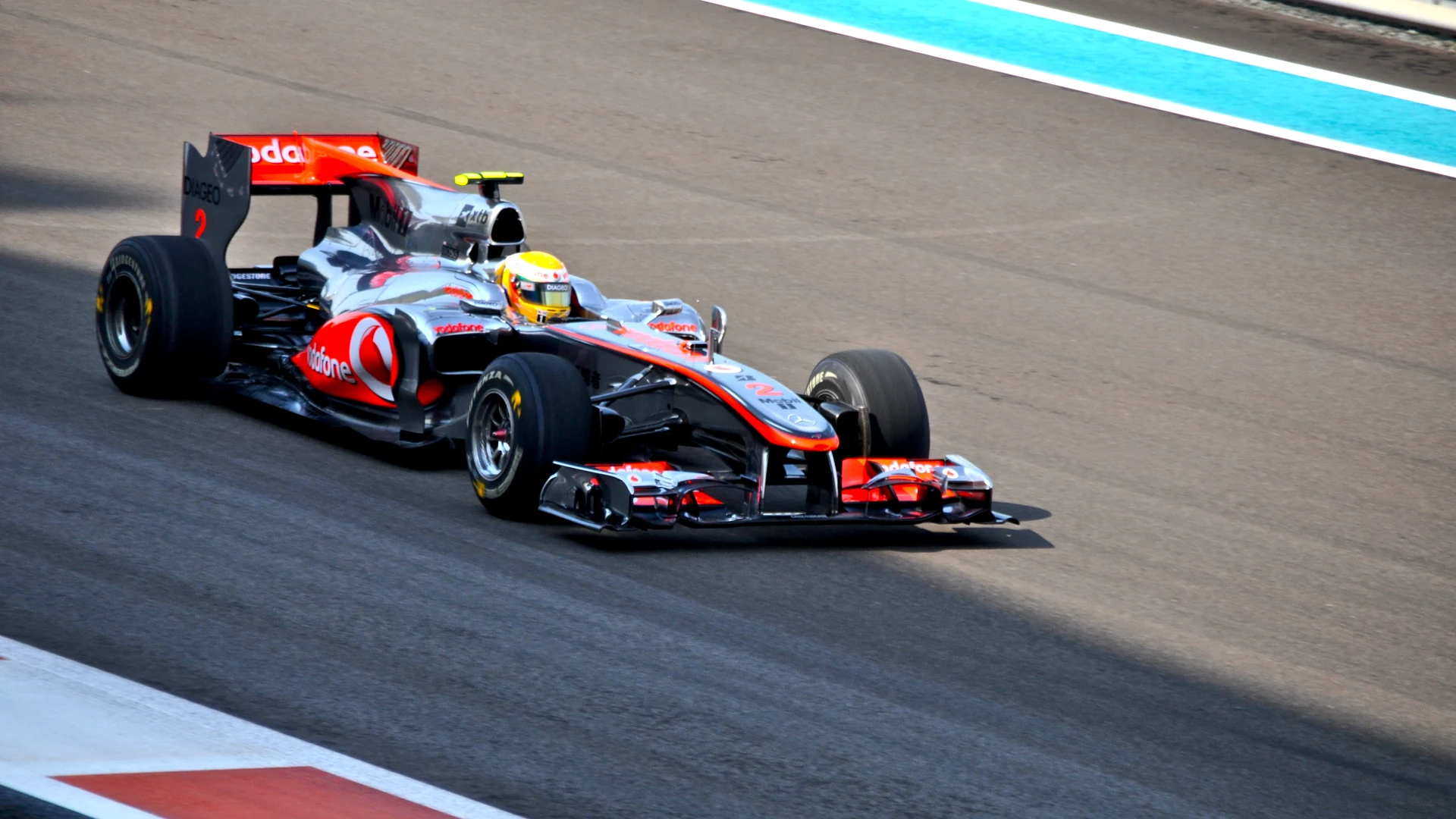
At a glance
Abu Dhabi’s Formula 1 story began in 2009 at Yas Marina, a purpose-built circuit on Yas Island. Sebastian Vettel won its first Grand Prix; a year later he left the same place as world champion. Those two evenings established a recurring theme: the driver who wins the race and the driver who wins the championship can have very different journeys to the flag. Circuit history.
For a first visit, understand two versions of the track. The slow chicanes visible in early recordings were substantially reworked for 2021. The modern lap retains the marina and hotel setting but links its main braking zones more directly. That distinction makes old race footage much easier to follow. Layout explained.
| Fact | Historical marker |
|---|---|
| First Grand Prix | 1 November 2009; Vettel won for Red Bull. |
| Modern race layout | 5.281 kilometres; 58 race laps in 2025. |
| Defining redesign | Three areas reconfigured before the 2021 race. |
| Championship landmark | Lando Norris secured his first drivers’ title here in 2025. |
The debut date and the latest championship landmark come from the 2009 result and 2025 classification.
Origins
Yas Marina grew out of plans announced in 2006 to develop Yas Island as a tourist destination. Construction of the circuit began in May 2007 and the project was completed by October 2009. Formula 1 arrived almost immediately, with the inaugural Grand Prix on the first day of November. It was a rapid transition from construction site to championship stage. F1 circuit guide.
The first race introduced Formula 1’s day-to-night format. Cars started in daylight and finished under floodlights, giving the event a changing appearance within a single Grand Prix. For spectators, that transition became part of the occasion: the same corner could look quite different by the time the leading cars returned for their final laps. First twilight race.
Its first sporting story was more complicated than a straightforward Red Bull celebration. Lewis Hamilton had taken pole for McLaren but retired with a brake problem. Vettel won ahead of Mark Webber, while Jenson Button finished third for Brawn after already securing that season’s world title. The new venue therefore opened with an established champion and a future champion sharing the podium. Debut result; first-race account.
That opening matters because Yas Marina’s reputation was shaped by its calendar position as well as its architecture. It closed the season in 2009 and 2010, then became the regular final round from 2014 through 2025. Drivers arrive at a finale with different objectives: some need the race win, others a particular finishing position, and teams can be fighting over places worth a whole season’s work. Finale history.
Read the early history through that tension. A circuit can reward the fastest car on Sunday while the championship rewards the driver who manages the final arithmetic. Yas Marina became a stage on which both stories were visible at once, with the grandstands watching the order on the road and the standings on the screens.
How the circuit has changed
The major physical turning point came in 2021. At the northern end, the former Turns 5 and 6 chicane disappeared and the old Turn 7 hairpin was widened. The revised corner became Turn 5. Removing the preceding interruption created a cleaner approach to the hairpin and the long straight beyond it. North hairpin changes.
At the southern marina, the old sequence of slow corners gave way to a broad, banked turn. F1’s guide identifies this as the new Turn 9. It altered the rhythm of the middle sector: an old onboard shows several separate changes of direction where a modern lap has one sweeping movement. The car’s exit from the preceding straight now feeds a very different cornering problem. Revised lap onboard.
The hotel section was also opened up on the inside of its corners. The circuit’s explanation focused on reducing the way cars bunched and then separated through the sequence, with less sliding and a better chance of remaining close for passing opportunities elsewhere. This was a redesign of how cars followed one another across a lap as much as a search for a spectacular individual corner. Hotel section rationale.
By the 2025 event, F1 listed the Grand Prix layout at 5.281 kilometres and the race at 58 laps. Those figures belong to the revised configuration. When comparing performances, first identify which route a driver used; an earlier race time or lap record carries the geometry of its own version of Yas Marina. Modern circuit statistics.
The useful viewing question is where a close pursuit begins. A pass into a braking zone often depends on the exit several seconds earlier. Follow a car through the hotel complex and onto the straight, then watch how its position changes approaching the next braking point. The 2021 work makes more sense when seen as a connected chain of corners.
Great races and moments
2010: a championship changes behind Petrov
Four drivers reached the 2010 finale with a mathematical chance of the title. Vettel won, but the decisive picture was further back: Fernando Alonso and Webber were trapped behind Vitaly Petrov’s Renault after their early stops. Alonso finished seventh and Webber eighth. A strategy intended to protect a championship position had left both unable to recover the track position they needed. Title-decider account.
Hamilton finished second and Button third, so Vettel’s victory alone did not explain the outcome. The final championship table put Vettel on 256 points and Alonso on 252. Watch that race with the standings beside the lap chart: Petrov’s place becomes central to the title even though he was racing for a much smaller reward of his own. Final 2010 standings.
2012: Räikkönen returns to the winning habit
Kimi Räikkönen took Lotus to victory in 2012, ahead of Alonso and Vettel. Hamilton’s retirement had removed the early leader, but Räikkönen still had to finish the job against a pursuing Ferrari. The result made the evening memorable well beyond its championship significance: a returning race winner had converted the chance placed in front of him. 2012 result; Räikkönen’s opportunity.
Vettel’s third place told another story. Excluded from qualifying because of a fuel issue, he started from the pit lane and recovered to the podium. The winner and the recovering title contender provide two different ways into the same race: follow Räikkönen to understand control at the front, then trace Vettel’s progress to see how much could change behind him. Pit-lane comeback.
2014: Williams share the championship podium
Hamilton’s title-winning race also produced a double podium for Williams. Felipe Massa finished second, 2.576 seconds behind him, and Bottas was third. Button brought his McLaren home fifth. Read beyond the new champion’s name and the classification shows several teams reaching the final evening with something tangible to celebrate. Full 2014 result.
The scores make this result immediately distinctive: 50 points for Hamilton, 36 for Massa and 30 for Bottas. They record the effect of the double-points finale, so an ordinary finishing position carried an unusually large reward. The experiment gave this particular Abu Dhabi race its own statistical signature, alongside the much more personal significance of Hamilton’s second championship. 2014 title context.
2016: winning slowly
Hamilton won the 2016 race while trying to draw other cars towards his team mate Nico Rosberg. Rosberg needed a sufficiently strong finish to become champion; Hamilton needed rivals to take places from him. By backing up the field, the leader attempted to turn a Mercedes one-two into a more dangerous contest for the second Mercedes. 2016 race report.
Rosberg held second ahead of Vettel and Verstappen, and the title was his. The unusual spectacle was a leader resisting instructions to increase his pace because outright speed no longer served his championship objective. For a newcomer, it is one of the clearest demonstrations that the quickest route to a race win and the best route to a world title can diverge. 2016 classification.
2021: the race and the FIA findings
Hamilton led much of the 2021 decider before Nicholas Latifi’s late crash brought out the Safety Car. Verstappen stopped for fresh soft tyres; Hamilton stayed out. Racing resumed for the final lap, Verstappen passed Hamilton and won his first world championship. The tyre difference and the restart put the two contenders into a final, direct contest. Race sequence.
The FIA’s March 2022 findings identified errors in the procedure. The Safety Car returned to the pits without completing the additional lap required by the regulations, and human error meant only some lapped cars were released. The FIA also concluded that the race director had acted in good faith under difficult circumstances and substantial pressure. FIA findings.
The same review confirmed that the race and championship results were final. Mercedes had protested, the stewards had dismissed the protest, and the team did not pursue an appeal. The enduring significance lies in both the sporting outcome and the shortcomings recorded by the governing body: Verstappen’s first title stands alongside a formal review of how the closing procedure was handled. FIA report.
2024–2025: McLaren’s two different celebrations
In 2024, Norris won as McLaren secured their first constructors’ championship since 1998. Piastri’s first-corner contact with Verstappen complicated the team’s afternoon, leaving Norris’s drive especially valuable. A year later Norris’s third place was enough for his first drivers’ title, while Verstappen won the race and Piastri finished second. 2024 race report.
Norris’s final advantage over Verstappen in 2025 was two points. His job at Yas Marina was to preserve a championship-winning position while handling pressure and traffic. Those consecutive finales make a useful pairing: the first rewards a team through its leading car’s victory, while the second crowns a driver who finishes behind both of his remaining title rivals. 2025 title report.
The British story at Yas Marina
Button’s third place at the inaugural race gave Britain an immediate podium connection with the venue. In 2010 the two McLarens finished second and third behind Vettel, Hamilton ahead of Button. It is an early reminder that a British podium celebration at Yas Marina could share the evening with somebody else’s championship breakthrough. 2010 race result.
Button had contested second place with Webber late in the 2009 race, so his podium came after a genuine on-track pursuit even with the championship already settled. That detail gives the opening event a human scale: the new world champion still had a race position to fight for. It is a useful thread to follow when watching a finale in which some season-long prizes have already been decided. Button’s debut podium.
Hamilton’s first Abu Dhabi victory arrived in 2011, with Alonso second and Button third. His later record at the circuit can make that first win seem inevitable in retrospect, but the debut had ended in retirement. The venue became a recurring part of his career through distinct episodes of mechanical disappointment, controlled victories and championship pressure. 2011 result.
The 2014 finale brought his second world championship. Hamilton passed pole-sitter Rosberg at the start; Rosberg then suffered an energy-recovery-system failure and finished fourteenth. Double points were awarded at this final round, giving Hamilton 50 for victory. The race’s unusual scoring makes the official result worth checking when comparing his winning points with other seasons. 2014 points and result; title-decider narrative.
His 2019 win completed another title-winning campaign, ahead of Verstappen and Charles Leclerc. That performance offers a calmer counterpart to the title deciders: a champion ending the year with a commanding race rather than waiting on events elsewhere in the field. Yas Marina’s British history includes that kind of authority as well as suspense. 2019 race account.
Hamilton’s final Mercedes start in 2024 began from sixteenth. He stretched the opening stint on hard tyres, switched to mediums and recovered to fourth, passing George Russell in the closing moments. While Norris carried the headline, another British story unfolded behind him: the ending of a major driver-team partnership through a sustained recovery drive. Hamilton’s farewell drive.
For a British visitor, these stories give several points of interest around the lap. The start recalls Hamilton’s decisive launch in 2014; the straights and braking zones recall his late pursuit of Russell a decade later. Norris’s 2025 championship adds a different example of composure. A race can be won by attacking a position or a season secured by recognising when the position already held is enough. Norris’s championship drive.
Records and numbers
These historical markers use results through the end of 2025. Hamilton and Verstappen were tied on five Abu Dhabi Grand Prix wins. F1’s preview listed Hamilton’s five before the 2025 race; Verstappen’s victory that December added to his previous four. A preview’s record table therefore needs its final Sunday result before it becomes an end-of-season record. Pre-race records.
The 2025 race classification supplies that final victory. Another useful number is the two-point gap separating champion Norris from Verstappen in the final standings, a margin which explains why third place mattered so much to the McLaren driver. Championship outcome.
| Fact | Historical marker |
|---|---|
| Joint winning benchmark | Hamilton and Verstappen: five Abu Dhabi wins each by the end of 2025. |
| 2010 title margin | Vettel finished four points ahead of Alonso. |
| 2014 winning score | Hamilton received 50 points under that finale’s double-points rule. |
| 2025 championship margin | Norris finished two points ahead of Verstappen. |
| 2025 race specification | 58 laps of the 5.281-kilometre layout. |
These numbers explain different things. A win total measures repeated success at the event; a title margin measures the whole season; a race distance describes a particular configuration. Keeping those categories clear helps you read the result without reducing every memorable evening to one supposedly definitive statistic.
A timeline
- 2006–2009: Yas Island development plans lead to circuit construction, completed in October 2009. Circuit origins.
- 1 November 2009: Vettel wins the inaugural twilight Grand Prix, ahead of Webber and Button. Opening race.
- 2010: Vettel wins the race and his first drivers’ championship as Alonso finishes seventh. Title-deciding result.
- 2011–2012: Hamilton takes his first Yas Marina victory; Räikkönen wins the following year for Lotus. 2011 result; 2012 result.
- 2014: Hamilton wins the double-points finale and becomes a two-time world champion. Championship account.
- 2016: Hamilton wins, but Rosberg’s second place secures the world title. Race classification.
- 2021–2022: A revised layout stages Verstappen’s first title; the FIA subsequently publishes its findings on the closing Safety Car procedure. Official review.
- 2024: Norris wins the Grand Prix as McLaren return to the top of the constructors’ championship. Team title.
- 2025: Verstappen wins the finale; Norris finishes third and becomes world champion. Final result.
See it for yourself
Choose the part of Yas Marina’s story you most want to understand before choosing a seat. A view of a braking zone helps you judge the final stage of an overtake; a wider sequence helps you follow how the gap was created. Use the modern circuit map alongside archive footage so the 2021 changes remain clear. Compare the revised lap.
The practical Abu Dhabi Grand Prix visitor guide brings the trip together, including ticket choices, travel and the weekend plan. Start there for arrangements, then use this history to choose the sessions and corners you particularly want to watch. The where to stay section helps connect your circuit plans with the rest of the visit.
Build time into your first evening to experience the changing light. The twilight format was part of the inaugural race’s identity, and watching the same stretch of tarmac before and after sunset gives the venue a distinctive sense of progression. Pay attention to the gaps between cars as well as the skyline: the sporting detail can be quieter than the setting. Twilight origins.
For preparation, read our guide to F1 night races and the first race weekend kit list. If you are comparing ticket types, grandstand or general admission explains the choices. Keep a short list of historical moments with you; recognising a corner from a particular race can turn a familiar broadcast image into a much more personal memory.
FAQs
When was the first Abu Dhabi Grand Prix?
The first Abu Dhabi Grand Prix took place on 1 November 2009 at Yas Marina. Sebastian Vettel won for Red Bull, ahead of Mark Webber and Jenson Button.
What changed at Yas Marina in 2021?
The northern chicane was removed, the hairpin widened, the southern marina sequence replaced and the hotel corners opened up. The work affected three areas of the circuit.
Who had the most Abu Dhabi wins at the end of 2025?
Lewis Hamilton and Max Verstappen were tied on five wins each after Verstappen won the 2025 race.
What did the FIA conclude about the 2021 finale?
The FIA recorded errors in the Safety Car procedure, found that the race director acted in good faith, and confirmed that the results were final.
Who became world champion at Abu Dhabi in 2025?
Lando Norris secured his first drivers’ championship by finishing third behind Verstappen and Piastri. His final advantage over Verstappen was two points.
Sources
- Confirmed: Formula 1: Yas Marina event and circuit guide
- Confirmed: Formula 1: onboard the revised Yas Marina layout
- Confirmed: Formula 1: 2009 Abu Dhabi race result
- Confirmed: Formula 1: 2025 Abu Dhabi race result
- Confirmed: Formula 1: defining Abu Dhabi moments, 2009–2013
- Confirmed: Formula 1: Yas Marina’s role as the season finale
- Confirmed: Yas Marina Circuit: the completed 2021 track renovation
- Confirmed: Formula 1: Abu Dhabi statistics before the 2025 race
- Confirmed: Formula 1: the 2010 and 2014 Abu Dhabi title deciders
- Confirmed: Formula 1: final 2010 drivers’ standings
- Confirmed: Formula 1: 2012 Abu Dhabi race result
- Confirmed: Formula 1: Vettel’s 2012 pit-lane recovery
- Confirmed: Formula 1: Rosberg becomes champion at Abu Dhabi in 2016
- Confirmed: Formula 1: 2016 Abu Dhabi race result
- Confirmed: Formula 1: 2021 Abu Dhabi race report
- Confirmed: FIA: findings of the Abu Dhabi 2021 analysis
- Confirmed: FIA: report to the World Motor Sport Council, 19 March 2022
- Confirmed: Formula 1: Norris wins and McLaren secure the 2024 constructors’ title
- Confirmed: Formula 1: Norris becomes champion at the 2025 finale
- Confirmed: Formula 1: 2010 Abu Dhabi race result
- Confirmed: Formula 1: 2011 Abu Dhabi race result
- Confirmed: Formula 1: 2014 Abu Dhabi race result
- Confirmed: Formula 1: Hamilton’s 2019 Abu Dhabi win