
At a glance
The Bahrain Grand Prix arrived in 2004 as Formula 1’s first World Championship race in the Middle East. Michael Schumacher led a Ferrari one-two at the new Bahrain International Circuit. The event acquired another defining feature in 2014, when floodlights turned its tenth anniversary into a night race. Its history combines a permanent circuit, changing configurations and some exceptionally revealing contests between team-mates. The circuit’s own history
Three layouts help organise the story. The familiar Grand Prix course measures 5.412 kilometres; the 2010 race used the longer Endurance configuration; the separately named Sakhir Grand Prix of 2020 used the short Outer course. Put the event title beside the map whenever looking at an old result. Each configuration changes the sequence a driver must master and the way a race develops. How the 2020 layouts differed
For someone travelling from Britain, Bahrain is an inviting race to understand through technique. Watch a car brake into Turn 1, pick up speed through the next changes of direction and then negotiate the downhill left at Turn 10. The circuit makes the relationship between braking, tyre grip and acceleration unusually clear. A small mistake can carry its cost along the following straight. The character of the Grand Prix track
The record here runs to the end of 2025. Start with the creation of the venue, then follow the experiments with its route and racing hours. The famous Hamilton–Rosberg duel becomes richer when you understand the first night race around it; the 2020 Sakhir drama becomes clearer when you know why the same complex was staging a different Grand Prix.
Origins
Construction began in December 2002 on a sandy site, according to F1’s circuit history. The purpose-built course was designed by Hermann Tilke. Its creation gave the championship a new destination and placed a major international motorsport venue in Bahrain, with a layout developed specifically for racing and its associated facilities. Building Bahrain International Circuit
The debut date is easy to remember: 4 April 2004. Schumacher took pole, then won ahead of Rubens Barrichello. A familiar Ferrari result established the first competitive reference point at an unfamiliar venue. For an archive viewer, it is worth following the entire field through the opening laps to see how quickly a new place becomes part of the sport’s normal vocabulary. The first Bahrain result
The new circuit offered a different visual language from an old European street race: open desert surroundings, substantial braking areas and a sequence of corners whose shapes could be read clearly on television. The challenge was in joining them together. A strong exit opened the next opportunity, while an overambitious entry could leave a driver struggling to put the power down.
F1’s account of the inaugural race also highlights the contest between Mark Webber’s Jaguar and Fernando Alonso’s Renault. That is a useful reminder of the interest beyond the leading Ferraris. A new Grand Prix creates its history across the field from the beginning, through individual battles that give particular parts of the circuit meaning. Racing during the inaugural event
Bahrain then became a place where a season’s early competitive picture could sharpen. Button’s 2009 victory for Brawn and Alonso’s 2010 win for Ferrari provide two different examples. One continued a newly successful team’s momentum; the other introduced an established champion to a major new chapter in his career. Button’s 2009 result
The 2010 classification records Alonso ahead of Felipe Massa, with Hamilton third, on the longer Endurance layout. The setting was familiar while the combination of driver, team and route gave the occasion its own character. Alonso’s 2010 Ferrari victory
The event’s later reputation grew through racing as much as through the new venue itself. The first visit provided the foundation, while changes in timing, cars and championship rivalries supplied the reasons to return to the archive. By the time the lights came on for the 2014 edition, Bahrain already had a decade of results for the new night spectacle to build upon.
How the circuit has changed
The Grand Prix configuration is the main thread: a 5.412-kilometre lap with heavy braking areas, technical slower corners and faster stretches that reward a well-balanced car. The sequence around Turns 9 and 10 is particularly instructive. F1’s driver guide explains how the turning approach unloads a front tyre and makes a lock-up easy to provoke. Why Turn 10 is demanding
In 2010 the Bahrain Grand Prix moved to the Endurance configuration, measuring 6.299 kilometres and containing 24 turns. The official result records 49 race laps, reflecting the longer journey around the circuit. This was a meaningful change of route within the same complex, offering a different rhythm from the more familiar Grand Prix lap. The Endurance configuration
Compare an onboard from that year with a recording on the Grand Prix course. Locate the branch into the additional sequence, then follow the steering workload until the car returns to familiar territory. The exercise makes a circuit map practical: an extra stretch of road changes the spacing of acceleration, braking and opportunities to recover between demands.
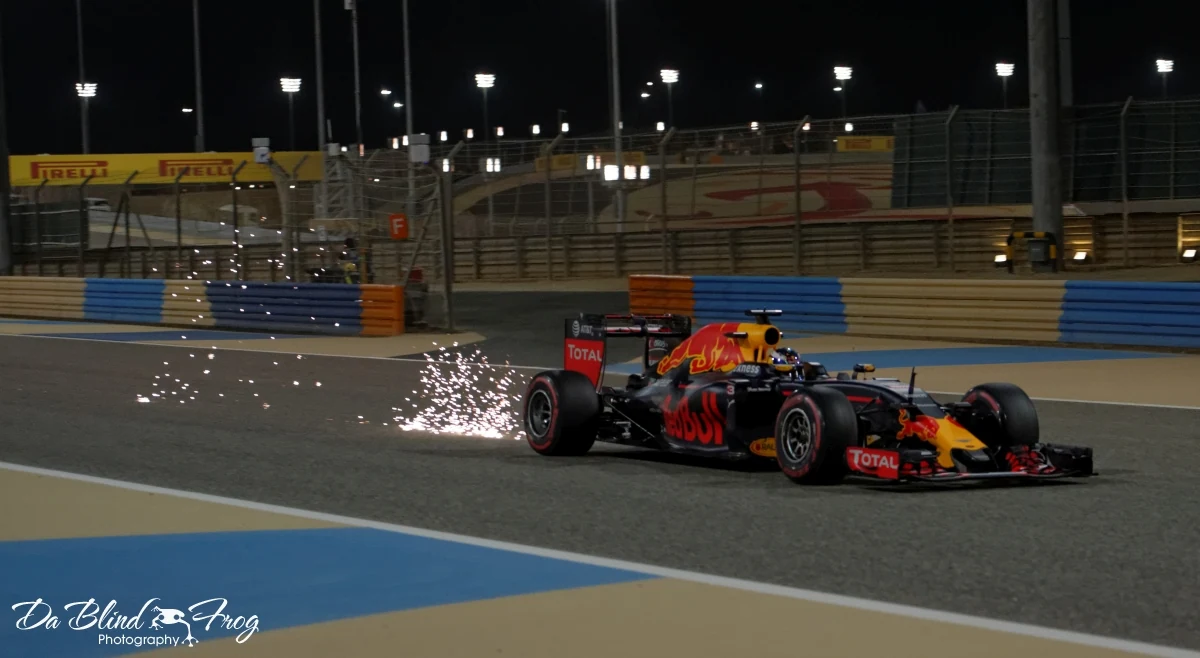
The 2014 change was about time and light. Floodlights installed at the circuit allowed the Grand Prix to be staged entirely after dark, with the start announced for six in the evening locally. F1 identified Bahrain as the third venue to hold all or part of a race in darkness, after Singapore and Abu Dhabi. The 2014 night-race announcement
The new appearance also highlighted the challenge of a changing environment. F1’s circuit guide describes wind and variations in temperature between sessions as part of finding the right set-up. The preparation a team completes in one set of conditions must still serve the driver when the conditions change. That gives an evening weekend a sporting rhythm as well as a striking visual one. Wind, temperature and set-up
The 2020 Outer layout supplied a third distinct experience. At 3.543 kilometres, it took a more direct route around the perimeter: cars turned left after Turn 4, passed through a fast section and rejoined the established track before the run towards the final corner. F1 used it for the Sakhir Grand Prix, the second of two consecutive race weekends at the venue. The Outer circuit route
Those configurations give a visitor several historical layers to recognise. Some corners will be familiar across recordings, while a car may suddenly take a different branch. Keep the year and event title on your chosen replay, then use a matching map to understand the lap. It turns apparent inconsistencies into evidence of a venue adapting its sporting possibilities.
Great races and moments
2009: Button turns opportunity into another Brawn win
Button won ahead of Vettel and Jarno Trulli in 2009. The result placed Brawn at the front of another early-season race and gives a British fan a useful companion to the team’s famous Australian debut. Watch how a driver’s work across the race produces the final advantage, even when several teams have a credible part in the contest. The 2009 finishing order
2014: Hamilton and Rosberg fight under the lights
Hamilton beat Mercedes team-mate Nico Rosberg by 1.085 seconds in Bahrain’s first night race. Their contest became one of the defining performances of the new hybrid era: two drivers using the same machinery, repeatedly challenging each other while keeping the fight alive. The official result puts the closeness of the finish beside the much longer effort that produced it. The 2014 classification
The appeal lies in the sequence of moves and responses. A successful defence at one corner can expose the driver at the next, and a challenger has to choose the moment that creates the strongest subsequent position. F1’s retrospective preserves the drivers’ appreciation of the intensity and fairness of the contest. The duel remembered
For a spectator, this is an excellent race to revisit before sitting near a linked sequence. Keep watching after the first attempted pass: the next corner may reveal what the previous move was really trying to achieve. A wide view helps the eye follow the developing argument between the cars, while an onboard reveals how much work keeps it controlled.
2019: Leclerc’s breakthrough slips away
Charles Leclerc led before a power-unit problem cost him the chance of victory. Hamilton won, while Leclerc finished third. The race is remembered through both outcomes: the official winner’s ability to capitalise and a young Ferrari driver’s lost opportunity after a strong performance. F1’s report follows the change in pace that transformed the closing part of the race. The 2019 race report
Notice how the interpretation changes when a fast car suddenly becomes vulnerable. A comfortable gap begins to function as a reserve of time, and each lap asks whether it will last. The experience can be compelling from a grandstand because the changing speed becomes visible on every return, even before the final order is settled.
2020: survival, response and investigation
Romain Grosjean survived a severe opening-lap accident and fire during the Bahrain Grand Prix on 29 November 2020. The FIA’s subsequent investigation examined the car’s protection, the barrier interaction and the medical and rescue response. His survival and the work of those who assisted him deserve a clear, respectful place in the event’s history. The FIA investigation
The investigation matters beyond the familiar footage. It shows the value of examining the whole sequence and feeding the findings into safety work. A historical account can recognise the seriousness of the accident, the effectiveness of protection and the effort of the response while keeping the focus on the people involved and the lessons drawn.
2020 Sakhir: Perez’s first win, Russell’s near miss
A week later, the Outer circuit staged the Sakhir Grand Prix. Sergio Perez recovered from early trouble to take his first victory. Russell, substituting at Mercedes, had led before a tyre mix-up and a later puncture derailed his challenge. Perez finished ahead of Esteban Ocon and Lance Stroll, completing a very different race story at the same venue. The Sakhir race report
The official Bahrain Grand Prix classification records Hamilton’s win on 29 November, while the following weekend’s event carries the Sakhir name. The distinction places both results accurately in the venue’s double-header history. The first weekend’s official result
2021: Hamilton holds the final challenge
Hamilton won the season opener after Verstappen caught him on fresher tyres. The Red Bull driver passed while running wide and returned the position, then Hamilton kept the lead to the finish. Their gap was 0.745 seconds. Watch the earlier pit stops as well as the final pursuit: they explain how the contest acquired its closing shape. The 2021 battle
2025: a measured McLaren breakthrough
Oscar Piastri won on his fiftieth Grand Prix start, taking McLaren’s first Bahrain victory. He controlled the race from pole and rebuilt his advantage after a Safety Car. Russell and Norris completed the podium. It supplied a new team milestone while demonstrating the enduring value of a strong restart and consistent pace. Piastri’s 2025 win
The British story at the Bahrain Grand Prix
Button’s 2009 victory gives the British story a memorable early chapter. The white Brawn at the front belongs to a particular competitive moment, when the team’s emergence changed expectations across the championship. Bahrain’s result repays attention alongside Melbourne because it shows success continuing after the initial surprise had become familiar. Button wins at Sakhir
Hamilton built the strongest Bahrain winning record: five victories through the end of 2025. The 2014 duel and 2021 finish provide especially accessible ways to understand that association. One places him against a team-mate in equal machinery, the other against a rival whose closing tyre advantage made the final laps increasingly difficult. Hamilton’s Bahrain record
Those races also show the variety contained within a repeat winner’s statistics. The number tells you that a driver returned successfully; the individual afternoons explain what success required each time. Watch where Hamilton places the car when defending, then consider the quality of the exit he needs to retain a useful position through the next acceleration phase.
Russell’s 2020 appearance belongs under the Sakhir Grand Prix heading. His opportunity in a Mercedes, the lead, the pit trouble and the recovery attempt explain why that evening remains important to British followers even though the victory went elsewhere. Naming the event accurately preserves its place in his career and keeps the standard Bahrain race’s record clear. Russell’s Sakhir appearance
The 2025 Bahrain podium added Russell in second and Norris in third. It gives a later reference point for travelling supporters following the generation after Button and Hamilton. The official result places the two behind Piastri, each having completed 57 laps, with Hamilton fifth for Ferrari. The 2025 British podium finishes
Choose a race around the skill you enjoy watching: Button converting pace into a result, Hamilton judging a sustained duel, or Russell trying to recover after an operational setback. This approach brings the British connection into the racing itself and offers a clear purpose for the next lap that passes your seat.
Records and numbers
All comparisons below are fixed at the end of the 2025 season. The three layout lengths refer to different configurations at Bahrain International Circuit. The familiar race lap record applies to the Grand Prix course, and the separately named 2020 Sakhir event is identified explicitly.
| Measure | Figure | Source |
|---|---|---|
| First Bahrain Grand Prix | 4 April 2004; Michael Schumacher won | Source |
| Grand Prix circuit length | 5.412 kilometres | Source |
| 2010 Endurance course length | 6.299 kilometres | Source |
| First Bahrain night race | 2014 | Source |
| 2020 Sakhir GP Outer course | 3.543 kilometres | Source |
| Most Bahrain GP wins through 2025 | Lewis Hamilton: five | Source |
| Grand Prix-course race lap record | Pedro de la Rosa, McLaren: 1:31.447 in 2005 | Source |
| 2025 Bahrain winner | Oscar Piastri, McLaren | Source |
A longer or shorter configuration changes the interpretation of a lap time. Match a timing claim to the route before comparing performances. That habit also makes the archive easier to enjoy: the extra sequence in 2010 and the fast Outer route in 2020 become distinct sporting experiments.
A timeline
- 2002: Construction begins on Bahrain International Circuit.
- 2004: Schumacher wins the inaugural Bahrain Grand Prix for Ferrari.
- 2005: De la Rosa sets the enduring Grand Prix-course race lap record.
- 2009: Button wins for Brawn.
- 2010: The Endurance course hosts a Ferrari one-two led by Alonso.
- 2014: The Grand Prix runs under floodlights for the first time; Hamilton defeats Rosberg.
- 2019: Hamilton wins after Leclerc’s late power-unit difficulties.
- 29 November 2020: The Bahrain Grand Prix is held; Grosjean survives his serious accident.
- 6 December 2020: Perez wins the separate Sakhir Grand Prix on the Outer layout.
- 2021: Hamilton wins the close season-opening contest with Verstappen.
- 2025: Piastri brings McLaren its first Bahrain Grand Prix victory.
The sequence traces a circuit acquiring new roles: regional pioneer, testing ground for another configuration, illuminated race venue and host of two distinct events on consecutive weekends. Use the dates to find the right map and the right sporting context for each recording.
See it for yourself
The Bahrain Grand Prix visitor guide is the practical companion to this history. Work through the UK journey, your base and the circuit transfer together, then compare the whole weekend cost. Give the trip enough structure that the evening race can be enjoyed without an uncertain journey home hanging over the final laps.
A view of more than one corner can be especially rewarding here because one attempted pass often shapes the next move. Our guide to grandstands and general admission helps you decide what matters most in a seat. Match that preference to the organiser’s current map and the actual product offered for your visit.
Use the night-races guide when arranging your daily rhythm, and build a manageable packing list with first race weekend kit. The F1 family guide is useful for planning breaks around the sessions your group most wants to see.
Take a short historical viewing plan: perhaps one clean lap through Turn 10, one sequence from the 2014 duel and the opening stages of the Outer-circuit race. Those examples give different parts of the venue a specific meaning. Once there, follow current spectator routes and event instructions while using the archive knowledge to appreciate what unfolds on track.
FAQs
When did Bahrain first host a Formula 1 Grand Prix?
The inaugural Bahrain Grand Prix took place on 4 April 2004. Michael Schumacher won ahead of Ferrari team-mate Rubens Barrichello, in the championship’s first race in the Middle East.
Why does the 2010 Bahrain Grand Prix use a different circuit map?
The 2010 race used the 6.299-kilometre Endurance configuration. It added a substantial section to the familiar Grand Prix course, and the race ran over 49 laps.
When did the Bahrain Grand Prix become a night race?
Bahrain staged its first fully floodlit Grand Prix in 2014, marking the tenth anniversary of the inaugural event. Hamilton won that first night race after the close contest with Rosberg.
How were the two Formula 1 races in Bahrain in 2020 different?
The Bahrain Grand Prix on 29 November used the Grand Prix course and was won by Hamilton. The Sakhir Grand Prix on 6 December used the 3.543-kilometre Outer circuit and was won by Perez.
Who held the Bahrain win record at the end of 2025?
Lewis Hamilton held the Bahrain Grand Prix record with five wins. Oscar Piastri won the 2025 edition for McLaren, while the published Grand Prix-course race lap record remained Pedro de la Rosa’s 2005 time.
Sources
- Confirmed: Bahrain International Circuit: Grand Prix history and three circuit layouts
- Confirmed: Formula 1: 2020 Sakhir Grand Prix on the Outer circuit
- Confirmed: Formula 1: construction and character of Bahrain International Circuit
- Confirmed: Formula 1: 2004 Bahrain Grand Prix result
- Confirmed: Formula 1: 2009 Bahrain Grand Prix result
- Confirmed: Formula 1: 2010 Bahrain Grand Prix result on the Endurance configuration
- Confirmed: Formula 1: Bahrain records published before the 2025 race
- Confirmed: Formula 1: Bahrain’s switch to a night race in 2014
- Confirmed: Formula 1: 2014 Bahrain Grand Prix result
- Confirmed: Formula 1: Hamilton and Rosberg’s 2014 Bahrain duel
- Confirmed: Formula 1: Hamilton wins after Leclerc’s 2019 reliability problem
- Confirmed: FIA: investigation into Grosjean’s 2020 Bahrain accident
- Confirmed: Formula 1: Perez’s maiden victory and Russell’s Sakhir near miss
- Confirmed: Formula 1: 2020 Bahrain Grand Prix result, 29 November
- Confirmed: Formula 1: Hamilton and Verstappen’s 2021 Bahrain finish
- Confirmed: Formula 1: Piastri wins for McLaren in Bahrain in 2025
- Confirmed: Formula 1: 2025 Bahrain Grand Prix result