
At a glance
The British Grand Prix is older than Silverstone’s championship history. Britain staged its first Grand Prix at Brooklands in 1926; Silverstone joined the story in 1948 and hosted the opening round of the new World Championship on 13 May 1950. Keeping those beginnings separate makes the rest of the history much easier to follow. Brooklands history The 1950 beginning
Silverstone’s appeal is the contrast between its ordinary origins and extraordinary speed. An airfield supplied the space; generations of racing supplied the meaning. You can watch a modern car flick through a familiar sequence of corners while imagining machinery with very different tyres, engines and levels of protection doing the same job.
- First British Grand Prix: Brooklands, 1926.
- First Silverstone Grand Prix: 2 October 1948; Luigi Villoresi won in a Maserati. Circuit history
- First championship race: Silverstone, 13 May 1950; Nino Farina won for Alfa Romeo.
- Most British Grand Prix wins through the end of 2025: Lewis Hamilton, nine. The ninth victory The 2025 result
Read this as a companion to a visit: learn why the circuit changed, choose a few races to revisit, then recognise their locations when you arrive. The modern venue and the event’s wider past overlap, but they are not identical.
Origins
Brooklands gives the British Grand Prix its first chapter. The Surrey venue staged the event in 1926 and again in 1927, long before the championship familiar to today’s fans. It is a useful corrective to the shorthand that Formula 1 simply began at Silverstone: the championship did, while Grand Prix racing already had a substantial life of its own. The pre-championship story
Post-war Britain presented a different opportunity. Silverstone was a former RAF airfield, and its early racing used the space left by military aviation. The first Grand Prix there, in October 1948, was won by Villoresi. The transformation was practical before it was romantic: a large available site could be adapted to racing when the country needed a major venue. Silverstone’s account
That airfield origin remains a helpful way to read the landscape. The long sightlines and broad sweep of the place feel very different from a street circuit hemmed in by buildings. Instead of making a town accommodate the cars, the racing gradually gave a new purpose to a site already designed for fast-moving machines.
In 1950 Silverstone supplied the opening scene for the World Championship. Farina led an Alfa Romeo podium sweep, with Luigi Fagioli and Reg Parnell behind him. The reigning monarch, King George VI, attended. The race was both a sporting contest and a public occasion, establishing a combination that later British Grands Prix would develop on a much larger scale. F1’s account of 1950
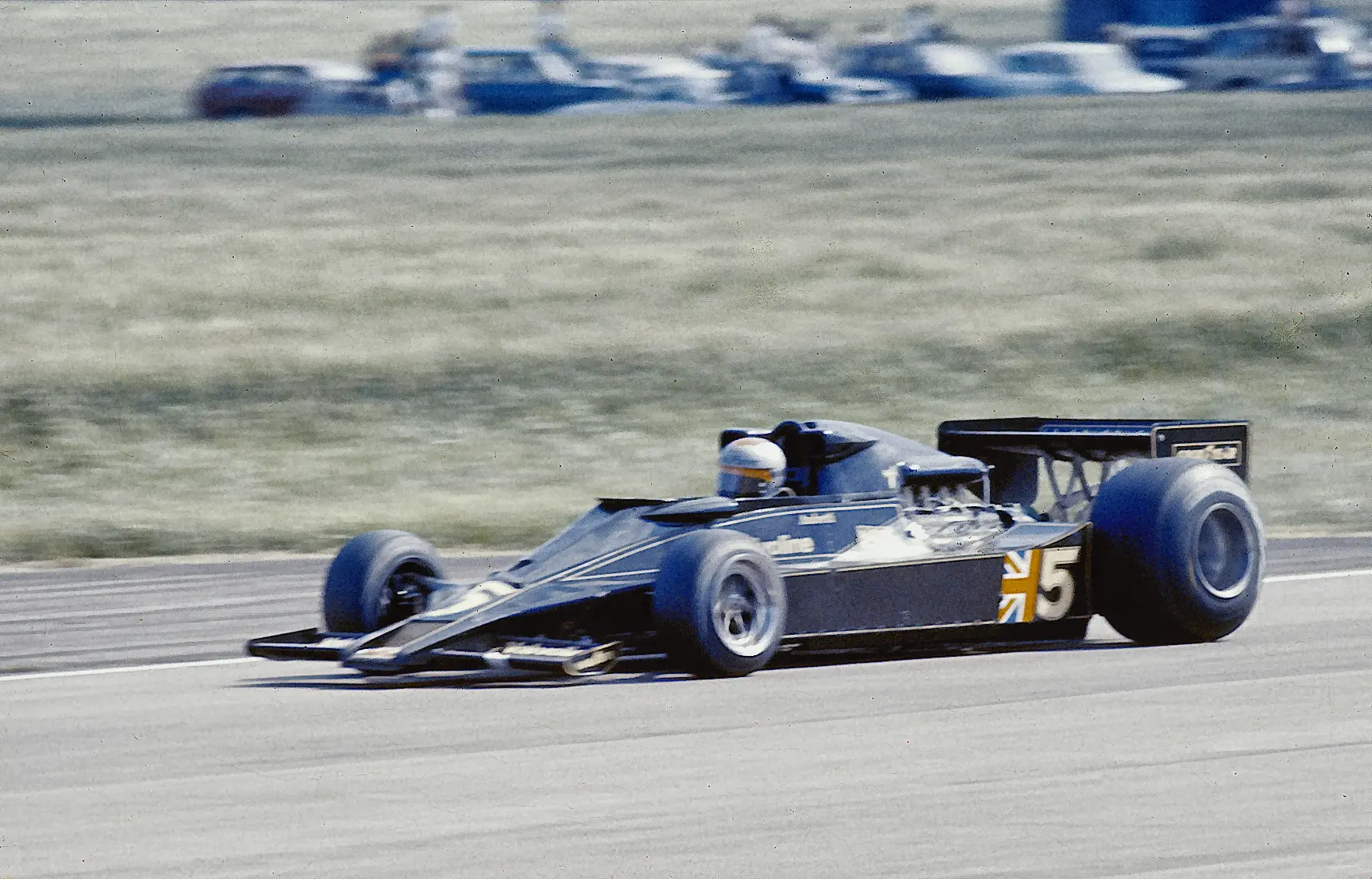
The cars in those photographs make the distance between eras tangible. Drivers sat high and exposed, and the trackside arrangements look sparse beside a modern Grand Prix. The interesting comparison is not simply that everything was smaller. It is how a recognisable competition—position, pace, reliability and judgement—survives while the machinery and surroundings change almost beyond recognition.
The event continued to travel. Aintree and Brands Hatch both became championship hosts before Silverstone became the permanent fixture from 1987. The sequence of British venues This matters when exploring an archive: a British Grand Prix photograph is not automatically a Silverstone photograph. Check the year and the circuit before trying to recognise a corner. An event name can remain constant while the sporting challenge beneath it changes entirely. The distinction also gives a modern trip a wider setting. Silverstone is the main destination for today’s race, but it is one chapter in a national story that also belongs to Surrey, Merseyside and Kent. The history became concentrated in one venue after being built across several.
For a first-time visitor, the dates provide three different landmarks: the birth of Britain’s event, Silverstone’s arrival, and the championship’s opening race. You do not need to remember every early winner. Remembering those distinctions will stop an old photograph, a museum label or a commentator’s reference from sending you down the wrong historical path.
How the circuit has changed
Silverstone has kept its fast character by changing the route around it. The outline on a modern ticket map is not the one Farina raced in 1950, and even much more recent archive film can put the start line somewhere unexpected. History here is a sequence of redesigns rather than a preserved original layout. The circuit’s development
The Woodcote chicane arrived for the 1975 British Grand Prix, slowing what had been a very quick part of the lap. A major redesign followed in 1991, reshaping the sequence around Maggotts and Becketts and creating a different approach through the infield towards Woodcote. These were substantial interventions, not changes that a driver could dismiss as a few new kerbs. The 1975 and 1991 milestones
The later transformation came in two stages. A new layout arrived in 2010, followed by the Wing pit complex and relocated start-and-finish arrangement in 2011. That distinction matters when comparing race starts: the first corner in one decade need not be the first corner in the next. The 2010–2011 changes
Today’s names preserve clues that a numbered circuit diagram would conceal. Wellington Straight and Hangar Straight remember the military airfield. Abbey recalls the nearby medieval abbey, while Becketts and Chapel recall a chapel associated with Thomas Becket. Maggotts comes from Maggots Moor. The names connect racing’s technical language to the ground beneath the tyres. The origins of the names
There is a wider event history inside the lap, too. Aintree and Brooklands honour former British Grand Prix hosts. Aintree staged five editions between 1955 and 1962; Brooklands held the two pre-war events. You can therefore pass reminders of the race’s travelling past while walking around its modern home. The former hosts remembered
The most rewarding comparison is to watch the direction changes rather than search for identical scenery. At Maggotts and Becketts, follow how quickly a driver must commit to one bend while preparing for the next. At Brooklands and Luffield, notice the contrast between heavy braking and the patience needed before accelerating away. For a first visit, our preference is a view that makes those changes of direction easy to follow.
Nor should an older corner name be treated as proof that nothing has moved. Circuits retain familiar words through revisions because spectators and competitors have built attachments to them. Carry a current map, then use the older map as a second layer. That is a more satisfying way to follow Silverstone than trying to force every decade into a single drawing.
Great races and moments
1951: Ferrari’s breakthrough
José Froilán González won for Ferrari at Silverstone in 1951, giving the team its first World Championship Grand Prix victory. An Argentine driver in an Italian car supplied one of the essential British Grand Prix stories: this home event has always helped make other people’s history, too. Official result The significance of the win
It is a good starting point for anyone who finds modern team reputations overwhelming. Ferrari’s success was not inevitable simply because the name later became famous. Looking back at the first win restores the uncertainty that a list of trophies tends to erase. Every established name once had to turn promise into a result.
1987: Mansell closes the gap
Nigel Mansell’s pursuit of Williams team-mate Nelson Piquet became a defining home-crowd afternoon. Mansell was 29 seconds behind with 28 laps remaining before cutting the deficit and passing Piquet at Stowe with three laps left. The dramatic pass mattered because the chase had made each preceding lap part of the story. F1’s account of the chase
Watch the approach to Stowe more than once. A passing move that appears sudden is the end of a long calculation about pace, space and the rival’s expectations. For a spectator, it demonstrates why following the gap on a screen can make the cars passing your seat feel more significant, rather than distract from them.
1991: the photograph after the victory
Mansell won again in 1991, and the lasting image came after the competitive work was done. Ayrton Senna had run out of fuel; Mansell stopped to give him a lift back on the Williams. F1’s archive records the gesture between drivers who were otherwise fierce rivals. The famous lift
The photograph captures something a results table cannot: the characters inhabiting the contest. It also reminds us that an image can become more famous than the race it came from. Enjoy it as a moment from its period, while recognising that historic behaviour around moving racing cars is not a guide to modern spectator access.
2008: Hamilton reads the rain
Lewis Hamilton’s first British Grand Prix victory was emphatic. In a wet race he finished 68.577 seconds ahead of Nick Heidfeld. The official classification fixes the size of the advantage; F1’s retrospective explains the exceptional control in changing grip. The exact result The wet-weather drive
A large winning margin can sound less interesting than a close finish. Here it is the evidence of the performance. Follow how the car changes direction without losing the rhythm that the conditions demand. The attraction is watching one driver make a difficult afternoon look manageable while the same track causes trouble elsewhere.
2022: Sainz gets his first win
Carlos Sainz converted his first pole position into his first Grand Prix victory at Silverstone in 2022. Sergio Pérez and Hamilton completed the podium after a race that brought a late Safety Car and fierce battles through the closing laps. The official race report
This is a useful replay for understanding why a first victory can take more than one kind of speed. A fast qualifying lap creates an opportunity, but the race asks new questions about tyres, traffic and decisions under pressure. Follow the cars around the winner as well: the excitement of the final phase extends well beyond the eventual finishing order.
2024: Hamilton reaches nine
Hamilton’s ninth British Grand Prix victory came in another wet-and-dry contest. He finished ahead of Max Verstappen and Lando Norris, taking his first win since 2021 and setting a new benchmark for victories at one Grand Prix. The emotional finish came after a demanding race in changing conditions. The 2024 race report
The home connection adds a layer that statistics cannot provide on their own. A crowd can recognise a long career in a single arriving car. Watching that finish after the much earlier 2008 drive shows the same venue marking two very different moments in one sporting life.
2025: a new home winner
Norris won the 2025 British Grand Prix ahead of Oscar Piastri, with Nico Hülkenberg taking his first Formula 1 podium in third. Piastri’s ten-second penalty for excessive slowing before a Safety Car restart affected the battle at the front. Norris kept his advantage when the race moved towards slick tyres. The official 2025 account
Norris added a new name to the home winners, while Hülkenberg’s achievement gave the afternoon a second emotional centre. That is one of racing’s pleasures: two supporters can leave the same grandstand remembering different drivers, different turning points and equally valid reasons why the day mattered.
The British story at home
Home success arrived at Aintree before it arrived at Silverstone. Stirling Moss’s 1955 victory was the first British win in the home Grand Prix. The result is certain; the old suggestion that Juan Manuel Fangio deliberately let his team-mate win remains speculation, not something to present as settled history. The 1955 story
Two years later, Moss and Tony Brooks shared a winning Vanwall at Aintree. F1 identifies it as the first World Championship victory for a British constructor. Shared drives belong to a very different rules era, so both names matter: reducing the result to the driver who took the flag removes part of the achievement. Why the shared victory matters
Jim Clark’s five British Grand Prix wins spread across the event’s different venues. His 1964 victory came at Brands Hatch, where Graham Hill and John Surtees made it an all-British podium. It is a vivid reminder that a country’s racing identity can grow through several places at once. Clark’s British total The Brands Hatch result The home podium
Later generations attached their own names to the summer occasion. James Hunt won at Silverstone in 1977; Damon Hill took his only British Grand Prix win there in 1994. These were distinct careers, with different machinery and pressures, linked in the public imagination by the response of the home crowd. Hunt’s victory Hill’s home success
The national story should leave room for everyone else. González’s Ferrari breakthrough, Senna’s presence in the Mansell years and Sainz’s first win all belong to this event. A British supporter does not have to choose between enjoying a home victory and appreciating an opponent’s exceptional afternoon.
That is our interpretation of Silverstone’s enduring appeal: it offers a familiar meeting place without requiring the race to repeat itself. The flags and favourite drivers change, while the feeling of recognising the place remains. For a first visit, choosing one older British driver to read about can make the circuit feel less anonymous before you have seen a car turn a wheel.
Records and numbers
Sporting records below stop at the end of the 2025 season. A British Grand Prix record concerns the event across its different hosts; a Silverstone record concerns the circuit. Those categories sometimes overlap and sometimes produce different answers.
| Measure | Figure and meaning |
|---|---|
| Most British Grand Prix wins | Lewis Hamilton, nine; his ninth came in 2024. Official report |
| Jim Clark’s British victories | Five. His final British win was in 1967. Career overview 1967 result |
| Modern Silverstone lap | 5.891 kilometres in the 2025 event specification. Official circuit data |
| 2025 race distance in laps | 52 scheduled laps. Official race report |
| Hamilton’s 2008 winning margin | 68.577 seconds over Heidfeld. Official classification |
Lap length and race length describe a particular configuration, not the entire history. Likewise, do not compare a qualifying time directly with a race fastest lap and assume they measure the same achievement. Fuel load, tyres, weather and the route itself shape the number.
The most useful record for a new spectator is one that sends you back to a race. Nine wins invite a comparison of Hamilton’s early and later visits; the 2008 margin invites you to watch the conditions. Numbers become more memorable when they point towards something you can actually see.
A timeline
- 1926: Brooklands stages the first British Grand Prix. Early history
- 1948: Villoresi wins Silverstone’s first Grand Prix. Circuit history
- 1950: Farina wins the first World Championship race at Silverstone. The championship opens
- 1951: González delivers Ferrari’s first championship Grand Prix win. The breakthrough
- 1955: Moss wins at Aintree. A home first
- 1964: Clark wins the British Grand Prix at Brands Hatch. Official result
- 1975: Woodcote gains a chicane. Circuit development
- 1987: Mansell passes Piquet at Stowe after his long pursuit. The chase
- 1991: A major circuit redesign changes the lap. The rebuilt route
- 2010–2011: The later layout and Wing transformation reshape the venue. The modern circuit
- 2024: Hamilton wins his ninth British Grand Prix. Record victory
- 2025: Norris wins at home; Hülkenberg reaches the podium. The final year covered
Use these milestones as a viewing order, rather than a test of memory. Moving between an early race, a redesigned circuit and a modern contest shows how much has changed while keeping the event recognisable.
See it for yourself
Start your own trip with the British Grand Prix visitor guide. It brings the ticket, travel and accommodation decisions together. History can help you decide which part of the circuit interests you, but the practical choice should also suit your budget, walking tolerance and journey home.
If the rapid direction changes drew you in, compare views around the Maggotts and Becketts sequence. If Mansell’s pursuit caught your imagination, put Stowe on your shortlist. A familiar story gives your chosen viewpoint a connection to earlier races.
Read grandstand or general admission before paying for a famous corner name. Consider how long you want to stand, whether you need a reserved seat and what you will do between sessions. A less celebrated position that suits your needs can be a better first experience than an ambitious plan you cannot comfortably carry out.
The UK race camping guide and first race weekend kit list help turn enthusiasm into a workable weekend. If you are arriving without a car, use the guide to UK circuits without a car alongside the event’s current transport information.
Finally, leave a little time simply to orientate yourself. Match the current map to the track, find your screen and facilities, then watch one sequence of corners closely for several laps. Recognising a place from an old race is satisfying; discovering what the cars actually do there is the reason to go.
FAQs
When was the first British Grand Prix?
The first British Grand Prix was held at Brooklands in 1926. Silverstone hosted its first Grand Prix in 1948, before the World Championship began.
Why is the 1950 British Grand Prix important?
Silverstone hosted the opening race of the Formula 1 World Championship on 13 May 1950. Nino Farina won for Alfa Romeo.
Has the British Grand Prix always been at Silverstone?
No. Brooklands hosted the pre-war races, and Aintree and Brands Hatch also staged the British Grand Prix during the championship era.
Who has won the British Grand Prix most often?
Through the end of 2025, Lewis Hamilton holds the record with nine victories. His ninth came at Silverstone in 2024.
Where should I start planning a first visit?
Start with the British Grand Prix visitor guide. Compare tickets, the journey and accommodation together, then use the seating, camping and kit guides to shape a weekend that suits you.
Sources
- Confirmed: Brooklands Museum: the first British Grand Prix
- Confirmed: Silverstone: circuit history
- Confirmed: Formula 1: the first championship race
- Confirmed: Formula 1: British Grand Prix moments
- Confirmed: Formula 1: Silverstone corner names
- Confirmed: Silverstone: the circuit from 1950 to 2025
- Confirmed: Formula 1: memorable Silverstone wins
- Confirmed: Formula 1: 1951 British Grand Prix result
- Confirmed: Formula 1: the shared Vanwall victory
- Confirmed: Formula 1: Jim Clark’s five British victories
- Confirmed: Formula 1: Senna and Mansell in 1991
- Confirmed: Formula 1: 2008 British Grand Prix result
- Confirmed: Formula 1: Hamilton’s 2008 wet-weather drive
- Confirmed: Formula 1: Sainz’s first victory in 2022
- Confirmed: Formula 1: Hamilton’s ninth British win in 2024
- Confirmed: Formula 1: Norris wins the 2025 British Grand Prix
- Confirmed: Formula 1: 2025 British event and circuit specification
- Confirmed: Formula 1: Clark’s 1967 British win
- Confirmed: Formula 1: Clark’s 1964 British win