
At a glance
The modern British Superbike Championship began at Donington Park on 31 March 1996. Niall Mackenzie won the first race on a Yamaha, while Terry Rymer won the other race at that opening meeting. Those results start the modern series’ story within Britain’s much longer motorcycle-racing tradition. The inaugural meeting.
BSB is the principal Superbike championship on its own race programme. Supersport and Superstock races on the supporting bill have separate titles and technical rules. A rider may progress between those categories, so a previous British championship mentioned in a biography needs its class attached before comparing it with a BSB crown. Championship overview.
| Historical marker | What it means |
|---|---|
| Modern series launched | Donington Park, 31 March 1996. |
| First modern champion | Niall Mackenzie, beginning three successive titles. |
| Six-title achievement | Shane Byrne reached six BSB championships in 2017. |
| Tiny title margin | Tommy Bridewell beat Glenn Irwin by half a point in 2023. |
| Champion at the end of this history | Kyle Ryde, winner in 2024 and 2025. |
The title format changed substantially when the Showdown was revised for 2023. Follow the points system used in the season you are watching. A close race finish, a meeting trophy and the overall championship can reward three different riders. The championship format.
Origins
Thirty-three riders qualified for the modern championship’s first race at Donington in 1996. Mackenzie’s Yamaha YZF750 supplied the opening victory, and Rymer’s Ducati the other. Beginning the account with that meeting keeps the modern series clearly identified while recognising that British riders and production-based competition already had a history before the BSB launch. The 1996 opening grid.
The first championship came down to Yamaha team-mates Mackenzie and James Whitham. They arrived at the final Donington round level on points; Mackenzie emerged champion by four. The opening season therefore established a tension which recurs throughout the history: riders sharing machinery and a team can still become each other’s most immediate obstacle to the title. The first championship battle.
Mackenzie followed his 1996 title with two more in 1997 and 1998. His three-year sequence gave the new championship an early reference point and a name that would return through his son Tarran. The family connection later became a concrete sporting comparison, because the younger Mackenzie would win the same principal championship rather than merely share a famous surname. Mackenzie’s early title sequence.
Ducati’s early title sequence adds other names to the modern series’ first decade. Troy Bayliss won in 1999, followed by Neil Hodgson in 2000, John Reynolds in 2001, Hislop in 2002 and Byrne in 2003. Hodgson later became a World Superbike champion, giving his British title a place in a wider career. The five-year sequence also shows how one manufacturer’s sustained success could encompass several different riders. Reading a bike’s badge and a rider’s name together reveals both the continuity of the machinery and the changing personal contest for the championship. Ducati’s early championship sequence.
Superbike machinery begins with production motorcycles and is developed within racing regulations. That connection provides a useful way into the spectacle: the underlying model may be familiar, while its braking, suspension, engine preparation and racing use belong to a tightly specified competition. Learning to recognise riders’ numbers makes the action easier to follow than relying on a bike’s colour alone. The Superbike starting point.
How the championship has changed
Technical development has repeatedly raised the question of how to keep competition affordable and close. The championship identifies 2012 as a significant change in that effort (the technical turning point). By 2025 its technical regulations specified the BSB engine-control system and restricted separate electronic control devices. The rules shape which engineering differences a spectator is watching, alongside the visible bravery of the rider. The 2025 technical framework.
The Showdown used from 2010 to 2022 divided the title contest into a main phase and a concluding phase. By its final season eight Title Fighters progressed into the decisive group. That selection mechanism made the approach to the cutoff a championship battle of its own, with riders competing to enter the group which could fight for the crown. The earlier Showdown structure.
For 2023 the championship removed that eight-rider restriction and let everyone continue accumulating championship points. Race wins normally brought eighteen points, increasing to twenty-five in the first two Showdown meetings and thirty-five at the Brands Hatch finale. The weighting still made the closing rounds particularly valuable, but the season’s arithmetic now operated through accumulated scores rather than a selected title group. The 2023 points change.
Sixteen riders remained mathematically in contention as the new Showdown began at Oulton Park in 2023. That breadth explains the intention of the revision better than the word Showdown alone. To follow a historic season, establish both who could still win the championship and how many points remained available; the same finishing position can have a different value in a different phase. The new format in practice.
The revised scoring also changes how to compare close title margins. Bridewell’s half-point advantage in 2023 came from that season’s accumulated results, while Ryde’s one-point success in 2024 belonged to the next campaign. Watching the decisive races with their own standings preserves the real choices facing each rider, including when a second place would be enough. Reading the close finishes.
The national championship has also raced beyond Britain. Assen returned to the schedule in 2025 after its previous BSB visit in 2019. This is a useful geographical detail when following archive footage: the series’ British identity describes its championship, while an individual round may have taken the riders to another country. The Assen return.
Great races and moments
1996: Rymer starts at the back
At Thruxton on 8 April 1996, Rymer won after starting last. He had missed qualifying while competing in the 24-hour motorcycle race at Le Mans and travelled back overnight. Mackenzie made a late chicane error, finishing third behind Whitham as Rymer took victory. Mackenzie then won the second race, in which Rymer retired. One meeting could therefore contain both a spectacular recovery and an immediate reversal of fortune. The last-to-first victory.
2011: six thousandths separate the rivals
Tommy Hill finished six thousandths of a second ahead of John Hopkins in the decisive Brands Hatch finale in 2011. That separation resolved their championship duel and gave the series one of its defining finish-line images. Watching the pair together is the essential point: the sporting question was which title rival crossed first, even as the wider race order continued around them. The Hill–Hopkins finish.
2018 and 2019: two routes to the title
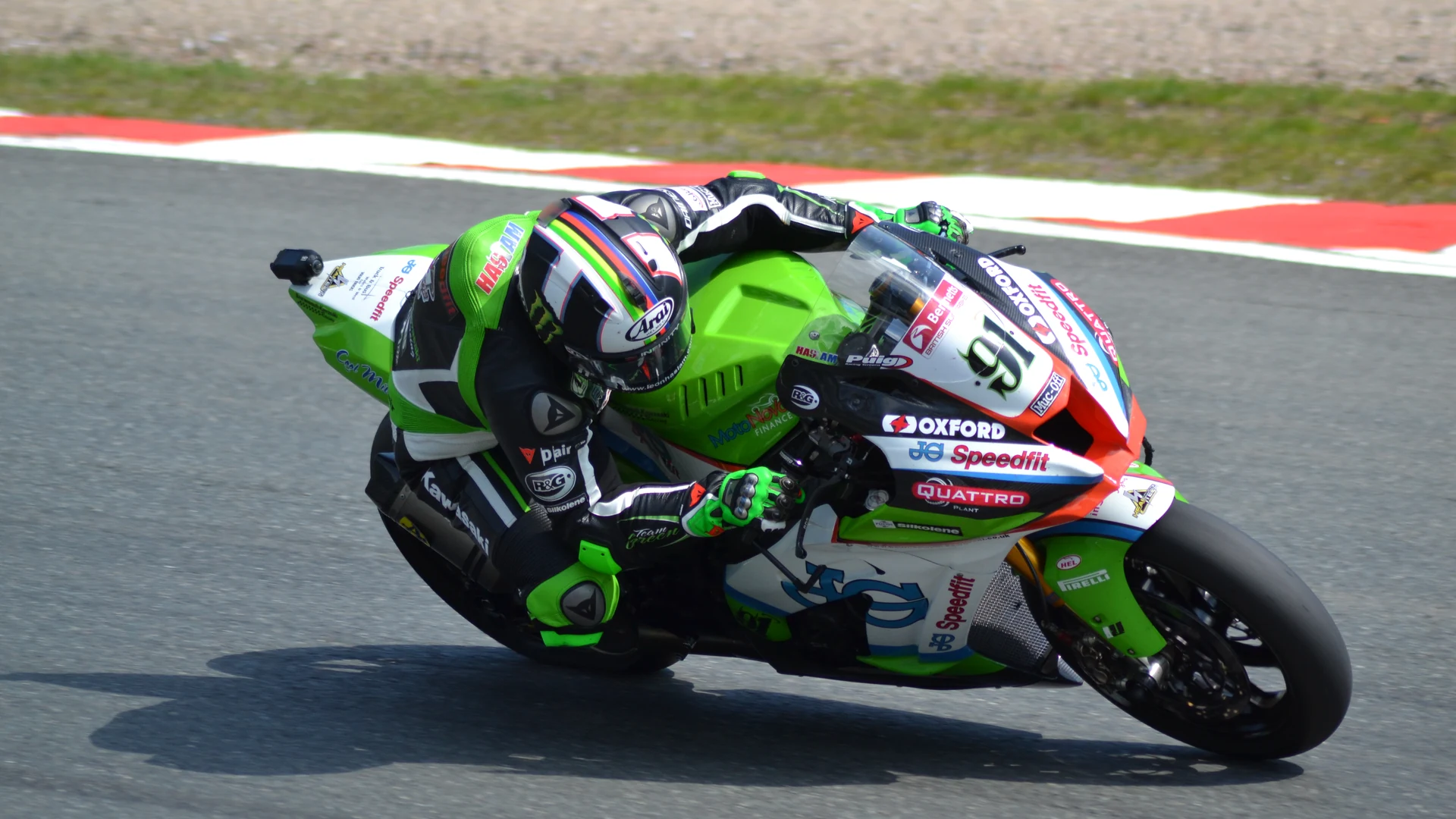
Leon Haslam’s 2018 championship season brought fifteen wins and six other podium finishes on a Kawasaki, with Jake Dixon runner-up. A title built with that volume of success offers a different perspective from a last-corner decider. Repeatedly finishing at the front creates the platform from which a contender can manage the final stage of a championship. Haslam’s title campaign.
Scott Redding won the championship in his first BSB season in 2019 after racing in MotoGP. Eleven victories and nine further podiums left him five points ahead of Josh Brookes. He then moved into World Superbike competition. His season shows a rider arriving with international experience and still having to learn how to put together a title campaign within this particular domestic series. Redding’s first-season title.
2021: the next Mackenzie completes a treble
Tarran Mackenzie won all three races at the Brands Hatch finale on the way to the 2021 championship. He had entered the Showdown thirty points behind the leader and finished the season with ten victories and nine other podiums. Twenty-five years after his father’s first crown, his own title was secured through a sustained closing attack with a particularly emphatic final weekend. Tarran’s championship finale.
2023: a treble, then a half-point championship
Bridewell’s first BSB treble came at Snetterton in July 2023. He won the last of those races just 0.032 seconds ahead of Irwin, with Haslam third. The narrow gap foreshadowed the season’s larger contest: the same two riders would reach the final round with very little separating them, making every result in their shared campaign worth revisiting. The Snetterton treble.
At the final Brands Hatch race, Irwin won while Bridewell passed Ryde at Druids on the last lap to take second. Those positions left Bridewell champion on 455 points, against Irwin’s 454.5. The race victory belonged to Irwin; the title belonged to Bridewell. Following the battle for second was therefore essential to understanding the outcome at the front. The half-point title decider.
2024: Ryde makes the decisive move
Ryde and Bridewell fought through the last Brands Hatch race in 2024 with the championship at stake. Ryde’s move at Hawthorn gave him the lead, and he defended through the closing corners to win by 0.296 seconds. The final championship totals were 487 to 486. A one-point title depended on the same two riders’ direct contest on the circuit. The one-point championship.
For an archive viewing, follow where each rider can prepare an attack rather than waiting for the pass itself. Their approach to Hawthorn and the defence towards Stirlings connect one corner’s exit to the next opportunity. The result is a useful introduction to watching the whole shape of a lap during a live championship battle. How the final battle unfolded.
2025: a home win helps the defence
At Donington, Ryde and Redding exchanged the lead through the Craner Curves, Old Hairpin and Starkey’s section. Ryde eventually won, with Bradley Ray second and Redding third, as his weekend developed into a treble. The sequence rewards a spectator who can see several linked corners: a move which succeeds at one point can leave the rider vulnerable at the next. The Donington duel.
That defence had taken time to gather pace. Ryde collected seven podium finishes before his first win of 2025, which came at the summer Brands Hatch meeting. Ray led him by fifty-two points after Knockhill; by the seventh round, at Cadwell Park, Ryde had moved two points ahead. The Donington treble belonged to that developing recovery. Reading the season backwards from the champion’s celebration would conceal how much ground he had needed to regain, and how the early podiums had kept the defence alive before victories began to arrive. The recovery through 2025.
Ryde completed his title defence at Brands Hatch in October, becoming the first rider to retain the BSB championship since 2017. He finished sixth in the final race, won by Danny Kent ahead of Ray and Bridewell. The final points were 522 for Ryde and 502 for Ray, giving the season a clearer numerical conclusion than the one-point finish of 2024. The final race and standings.
The British riders who shaped it
Shane Byrne’s sixth championship in 2017 established a formidable title benchmark. His team’s history records that he overturned a thirty-three-point deficit entering the final Brands Hatch round. The achievement connects a long career of titles with the need to deliver under pressure at one particular meeting; an established champion still had to find the results which the final points calculation demanded. Byrne’s sixth championship.
The same team history links Steve Hislop’s 2002 championship with Byrne’s first in 2003. These names give a newcomer a way into successive generations before the later title deciders became familiar. Reading them as a sequence of champions also keeps the principal BSB crown distinct from successes in the many other British motorcycle classes. Hislop and Byrne’s title years.
Haslam’s 2018 title and Redding’s 2019 success demonstrate different career routes into a British championship. Haslam built a season around repeated Kawasaki wins; Redding arrived from international Grand Prix racing and won immediately. Their neighbouring titles make a useful comparison when watching a field containing both long-established BSB competitors and riders bringing experience from elsewhere. Haslam’s winning season.
Tarran Mackenzie had already won the British Supersport championship in 2016 before becoming BSB champion in 2021. The class distinction matters: the earlier title was a stage in his career, while the later success placed him alongside his father among Superbike champions. It is a clear example of why the full championship name belongs beside a rider’s year of success. Mackenzie’s route through the classes.
Ray sealed his first BSB title by finishing fifth in the Brands Hatch Sprint race on Saturday 15 October 2022, when Glenn Irwin won. His title was therefore already secured before the final day of that meeting. A weekend timetable can contain the decisive championship moment earlier than a first-time visitor expects, making the Saturday races part of the full sporting story. Ray’s championship-clinching finish.
British riders have also competed against important international champions. Japan’s Ryuichi Kiyonari retired in December 2025 with three BSB titles and fifty victories from 236 appearances. His record gives the British series an international dimension while remaining a set of results earned in this championship. The riders’ backgrounds widen the story without changing which trophy they were competing to win. Kiyonari’s BSB record.
Records and numbers
Small numbers explain several of BSB’s best-known finishes: Hill’s advantage over Hopkins was 0.006 seconds in 2011; Bridewell’s title margin was half a point in 2023; Ryde’s was one point in 2024. A time gap measures a finish, whereas a points gap measures a championship. Keeping the units beside the figures preserves what each achievement actually settled. The 2023 championship arithmetic.
| Historical marker | What it means |
|---|---|
| Niall Mackenzie’s opening sequence | Three successive titles, 1996–1998. |
| Byrne’s championship benchmark | Six titles reached in 2017. |
| Kiyonari’s completed BSB record | Three titles and fifty wins, recorded at retirement in 2025. |
| 2024 championship finish | Ryde 487 points; Bridewell 486. |
| 2025 championship finish | Ryde 522 points; Ray 502. |
A meeting can also carry its own trophy. At Cadwell Park in 2024, Bridewell won the second race, but Ryde took the King of the Mountain award through the highest combined score from the first two races. Neither result alone was the season’s BSB championship. This local example makes the different layers of achievement particularly easy to see. Cadwell’s separate awards.
A timeline
- 1996: The modern series begins at Donington; Mackenzie and Rymer share the first meeting’s wins. Opening meeting.
- 1996–1998: Mackenzie wins the first three championships of the modern series. The early champion.
- 2002–2003: Hislop wins the title, followed by Byrne’s first championship. The team history.
- 2010–2012: The Showdown begins, Hill and Hopkins produce the 2011 decider, and technical changes follow in 2012. Sporting format; Technical development.
- 2017–2019: Byrne reaches six titles; Haslam wins in 2018; Redding becomes champion in his first season the following year. Byrne’s milestone; Redding’s arrival.
- 2021–2022: Tarran Mackenzie and then Ray win their first BSB championships. Mackenzie’s title; Ray’s first crown.
- 2023: A revised Showdown points structure precedes Bridewell’s half-point title over Irwin. Revised competition; Final outcome.
- 2024: Ryde beats Bridewell to the title by one point after winning the last race. First Ryde title.
- 2025: Ryde recovers from a fifty-two-point deficit after Knockhill, wins three times at Donington and successfully defends his championship. The successful defence.
See it for yourself
Use the British Superbikes visitor guide to choose your first meeting and connect tickets with the travel plan. Pick a venue whose features interest you. A view across connected corners helps explain the changing position of two rivals, while a braking zone makes their individual attack and defence easier to read.
The Brands Hatch guide pairs naturally with the 2023 and 2024 title deciders. Watch one before travelling, then identify the named corners on the circuit map. For Donington Park, follow the 2025 Ryde–Redding battle through the Craner Curves and Old Hairpin to see why a pass can be only the first move in a longer exchange. The Donington sequence.
At Cadwell Park, keep the meeting’s King of the Mountain award separate from the race results and overall standings. Learning those three competitions gives each session a purpose. The local scenery and circuit shape are part of the experience, but the points explain why a rider may celebrate even when another bike reaches the flag first. The meeting trophy explained.
Read riding to the races if travelling by motorcycle, and camping at UK races for a full weekend stay. Our weekend kit guide covers what to bring. Keep the support-race names beside the timetable, so you know which championship is on track and which set of standings to follow between sessions.
FAQs
When did the modern British Superbike Championship begin?
The modern series began at Donington Park on 31 March 1996. Niall Mackenzie and Terry Rymer won the opening meeting’s races.
Who was the first modern BSB champion?
Niall Mackenzie won the 1996 championship, then retained the title in 1997 and 1998.
Are British Supersport and BSB the same title?
They are separate championships. Tarran Mackenzie won British Supersport in 2016 and BSB in 2021, illustrating the distinction.
What changed in the Showdown for 2023?
The championship removed the eight-rider title-group restriction. Everyone continued scoring, with larger points awards in the final three meetings.
Who was BSB champion at the end of 2025?
Kyle Ryde retained the championship after his first title in 2024. He finished 2025 on 522 points, twenty ahead of Bradley Ray.
Sources
- Confirmed: British Superbikes: the modern championship’s first meeting in 1996
- Confirmed: British Superbikes: championship overview
- Confirmed: British Superbikes: sixteen contenders enter the 2023 Showdown
- Confirmed: British Superbikes: the 1996 Mackenzie–Whitham title battle
- Confirmed: Brands Hatch: a century of sporting landmarks
- Confirmed: Ducati: British championship title winners from 1999 onwards
- Confirmed: British Superbikes: production origins and technical changes
- Confirmed: MSV: 2025 British Superbike technical regulations
- Confirmed: British Superbikes: the points format introduced for 2023
- Confirmed: British Superbikes: Kyle Ryde takes the 2024 title by one point
- Confirmed: British Superbikes: the championship returns to Assen in 2025
- Confirmed: British Superbikes: Terry Rymer’s last-to-first Thruxton victory in 1996
- Confirmed: British Superbikes: Leon Haslam’s 2018 title campaign
- Confirmed: British Superbikes: Scott Redding’s 2019 championship season
- Confirmed: British Superbikes: Tarran Mackenzie’s 2021 title
- Confirmed: British Superbikes: Bridewell completes his first treble at Snetterton
- Confirmed: British Superbikes: Tommy Bridewell wins the 2023 title by half a point
- Confirmed: British Superbikes: Ryde and Redding duel at Donington in 2025
- Confirmed: British Superbikes: Ryde completes his 2025 championship defence
- Confirmed: British Superbikes: the final race and championship standings of 2025
- Confirmed: British Superbikes: the PBM team’s championship history
- Confirmed: British Superbikes: Bradley Ray seals the 2022 title
- Confirmed: British Superbikes: Ryuichi Kiyonari’s retirement and championship record
- Confirmed: British Superbikes: Cadwell’s 2024 race winner and King of the Mountain