
At a glance
The Chinese Grand Prix began at Shanghai International Circuit in 2004. Its history brings together a striking new venue, major career landmarks and races in which judging the grip mattered as much as outright speed. Rubens Barrichello won the first edition; Lewis Hamilton accumulated six victories by the end of 2025. The inaugural result The winning record
The circuit is recognisable before you learn the corner numbers. A tightening opening spiral asks the driver to keep slowing while turning; a long back straight leads to a much more abrupt braking test. That mixture provides a useful thread through the archive: follow the tyres, the decisions made about them and the opportunities those decisions create.
- First race: 26 September 2004, won by Barrichello for Ferrari.
- Venue: Shanghai International Circuit, in Jiading.
- 2025 configuration: 5.451 kilometres and 56 scheduled race laps. Circuit specification
- Memorable firsts: Red Bull’s maiden win in 2009 and Nico Rosberg’s first victory in 2012. The breakthroughs
For a first visit, this history gives the unfamiliar map some meaning. Turn 6 recalls Daniel Ricciardo’s decisive move; the pit entry carries a very different Hamilton memory. Learn a few of those connections before choosing what you want to watch.
Origins
Shanghai was built for Formula 1. In April 2003, marshland in the city’s Jiading district was earmarked for the project; eighteen months later the circuit was complete. F1’s account records an unusually rapid transformation from an undeveloped site into a major international sporting venue. The circuit’s beginnings
That origin is visible in the scale of the place. A permanent venue allowed the lap to develop its own spacious geometry, with slow, sustained turns set against fast changes of direction and a very long straight. The result offered more than an impressive aerial image: it gave racing cars several different problems to solve within the same lap.
The outline was designed to resemble the Chinese character for “shang”, meaning upwards. The reference connects the circuit to Shanghai’s name while giving the map a distinctive identity. At ground level, however, it is the changing radius of the corners that makes the design memorable. A driver entering the opening right-hander must keep adjusting as the road tightens. The design reference
China and Bahrain both joined the championship in 2004. Ferrari won both inaugural events, with Michael Schumacher successful in Bahrain and Barrichello in Shanghai. F1’s account of the debut The new setting therefore introduced a different stage during an established team’s period of strength. A modern-looking venue did not make its first result predictable for every driver: even team-mates could have very different weekends.
On 26 September, Barrichello finished 1.035 seconds ahead of Jenson Button’s BAR-Honda, with Kimi Räikkönen third for McLaren. Official classification The narrow winning margin makes a useful introduction to the event. Watch the opening race without assuming that Ferrari’s wider success means the afternoon contained no pressure.
The place in the calendar changed early. Shanghai hosted the 2005 season finale, then moved from its original late-season position into the opening part of the championship in 2009. The calendar history This explains why older Chinese Grands Prix can feel so different in the season’s story. A race near the conclusion can settle or damage a title challenge; an early visit can reveal a new competitive order still taking shape.
How the circuit has changed
Shanghai’s history is easier to read through the experience of the lap than through a list of wholesale redesigns. The 2025 event still used a 5.451-kilometre course. Its tightening Turns 1 and 2, the direction change through Turns 3 and 4 and the fast sweep through Turns 7 and 8 remained central to its character. The 2025 layout
Those opening corners make a good archive comparison. Watch the steering movement and listen for the engine note falling as the car continues to turn. Speed alone will not carry the driver through a bend that keeps asking for a tighter line. Different generations of car make that challenge look different, while the shape of the task stays recognisable.
At the other end of the lap, the long right-hand sequence releases the cars onto the back straight towards Turn 14. F1 describes the straight as 1.2 kilometres long. The contrasting sections For a spectator, this creates two connected things to watch: how cleanly a car accelerates out of the preceding corner, and what the following driver can do with the run towards the hairpin. The pass often begins before the straight itself.
A major interruption arrived off the track. The Chinese Grand Prix was absent from 2020 to 2023 because of the Covid-19 pandemic, returning in 2024. The four-year gap An archive jumps directly from Hamilton’s 2019 victory to a much later generation of cars and drivers. Recognising that break helps explain why the return carried such significance beyond the result.
The surface then supplied a fresh technical chapter. The FIA’s March 2025 practice report describes a newly resurfaced, grippy track. Norris headed that sole practice session before Sprint Qualifying. The new asphalt in 2025 The map looked familiar, but teams had limited running in which to understand the new grip. History at a permanent circuit can change through asphalt and tyres without requiring a new corner.
Shanghai also hosted a Sprint weekend in 2025, adding a separate short race and its own qualifying session to the programme. The weekend format Keep the sessions distinct when comparing results. Hamilton’s Saturday victory and Piastri’s Sunday win belong to the same weekend, but they answer different sporting questions. That distinction becomes particularly useful when reading a headline about a first win for a team.
Great races and moments
2006: Schumacher’s final victory
Michael Schumacher won his 91st and final Formula 1 Grand Prix in Shanghai in 2006. The wet-to-dry contest ended with Fernando Alonso second and the title rivals level on points. The final win It is a compelling replay because the significance operates on two timescales: an immediate championship battle and a career milestone whose finality became clear later.
Try watching without mentally supplying the later ending to Schumacher’s career. The attraction is the unsettled afternoon in front of the drivers, with conditions changing and a rival still close enough to matter. Retrospective fame can obscure the uncertainty that made the performance worth remembering.
2007: a championship opportunity in the gravel
Hamilton arrived as a rookie with a chance to secure the championship, but his race ended at the pit entry. On badly worn intermediate tyres, he slid into the gravel while attempting to reach the pits. Räikkönen won. The retirement and its setting The scene remains one of Shanghai’s most recognisable images because such a small distance separated the stranded car from the service it needed.
Follow the preceding laps as well as the famous stop. The tyre condition gives the image its meaning. It is a reminder that a Grand Prix can turn on the journey into the pit lane, even while attention is focused on the cars circulating at racing speed.
2009: Red Bull becomes a race winner
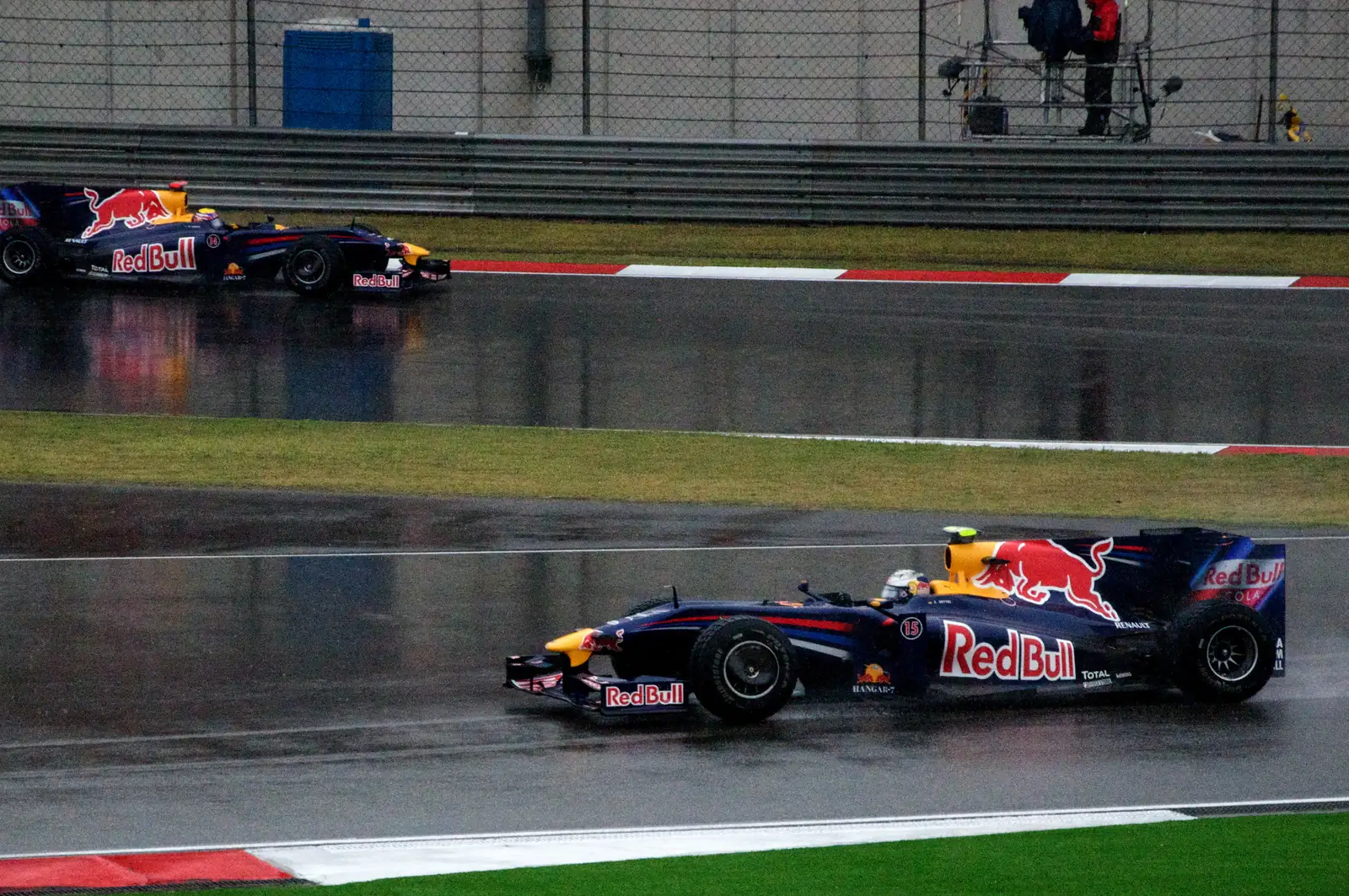
Sebastian Vettel delivered Red Bull’s first Formula 1 victory in the rain, with Mark Webber completing a one-two finish. The team’s breakthrough A later viewer knows how prominent the team became. Watching this race restores the earlier moment when winning still represented a new achievement, rather than another addition to a familiar total.
The paired result matters. One fast car taking a chance can be remembered as an isolated breakthrough; two team-mates finishing at the front give the afternoon a different shape. The photograph of the Red Bulls on the wet circuit belongs to that first chapter.
2012: Rosberg and Mercedes break through
Nico Rosberg converted pole into his first Grand Prix victory in 2012. It was also the first win for a Mercedes works team since 1955. The 2012 landmark The event therefore joined an individual beginning to the return of an older name, connecting a modern career to a much longer team history.
This is a useful race for understanding why identical finishing positions can carry different emotional weight. A first victory changes what a driver has already achieved. A returning manufacturer’s first win changes how a project is judged. Shanghai hosted both developments on the same afternoon.
2018: Ricciardo makes the tyre advantage count
Red Bull brought both cars in for fresh soft tyres under the Safety Car in 2018. Ricciardo then worked through the leading group and passed Valtteri Bottas at Turn 6 for the lead, going on to win. The strategy and decisive pass The stop created the possibility; the overtakes converted it into a result.
Watch where Ricciardo places the car before braking. The interest lies in the combination of preparation and commitment: better tyres help, but the rival still occupies the road. Turn 6 becomes easier to recognise after following that move from approach to exit.
2019: the thousandth championship race
Shanghai staged the 1,000th World Championship race in 2019. Hamilton passed pole-sitter Bottas at the start and won, with Bottas second and Vettel third. The milestone race The large number belongs to the championship’s full history; the Chinese event itself was still a comparatively young part of it.
That combination gives the race its appeal as a viewing choice. An occasion celebrating the sport’s accumulated past took place at a circuit built during the modern expansion of its calendar. The anniversary and the venue tell different parts of the same story.
2024–2025: homecoming and a new winner
For Zhou Guanyu, the 2024 return meant a first chance to race at home after entering Formula 1. He finished 14th in the Grand Prix and was given space on the main straight to acknowledge the crowd. Zhou’s home weekend The scene shows how the emotional centre of an event can sit well beyond the podium.
In 2025 Piastri won ahead of McLaren team-mate Norris and Mercedes driver George Russell. The 2025 race report The contrast with the rain-affected archive is rewarding: the same venue accommodates different kinds of race, while each edition adds another association to a familiar piece of track.
The British story in Shanghai
Button gave British supporters an early connection to Shanghai by finishing second in the inaugural race. The 2004 podium His victory came in 2010, when he stayed on slick tyres as many rivals switched to intermediates. A Safety Car erased his advantage, but he held on to lead Hamilton home in a McLaren one-two. Button’s tyre judgement The final order
Button’s race repays patient viewing. Concentrate on what the track is doing and how long a driver can tolerate a tyre that appears unsuitable. A changing surface makes the decision more complicated than choosing the tyre associated with the weather on a forecast. The advantage comes from recognising what the car can actually sustain.
Hamilton’s Shanghai career spans the painful 2007 retirement and a record six Chinese Grand Prix wins through the end of 2025. His 2019 victory was the sixth. The early setback The sixth win Placing those races side by side gives the venue a particular role in his career: it preserved an early disappointment and later became one of his most successful stops.
The 2011 race provides another British win to revisit. Hamilton took victory while Webber recovered from 18th on the grid to third. The 2011 race Following the podium finisher who started near the back makes the race feel wider than the leading battle, and helps a new fan practise reading more than one story at once.
Hamilton added a distinct achievement in the 2025 Sprint, taking his first victory in a Ferrari ahead of Piastri and Verstappen. The Saturday Sprint This was a Sprint success, so the Chinese Grand Prix wins total remained six at this history’s cutoff. The session label preserves the scale and meaning of the result.
Norris’s Sunday second place came despite a developing brake problem in the closing stages. The McLaren team asked him to avoid risks, and he reached the flag ahead of Russell. The late brake concern Watching that finish gives an apparently comfortable team result a different texture. The driver behind Piastri was managing a problem that the gap to the leader could not fully explain.
The final classification also changed later that day. Leclerc and Pierre Gasly were disqualified for underweight cars, while Hamilton was disqualified because his Ferrari’s plank assembly was below the permitted minimum thickness. The technical decisions When revisiting the weekend, follow the published final order alongside the footage: the cars reaching the flag and the points eventually awarded tell connected stages of the result.
For a UK visitor, Shanghai’s British story can begin with several different generations and styles: Button’s judgement, Hamilton’s long record, or the newer drivers challenging at the front. Choosing one race from each makes a more varied introduction than following a single collection of wins.
Records and numbers
Sporting records here stop at the end of 2025. Sprint results are recorded separately from Chinese Grand Prix victories.
| Measure | Figure and context |
|---|---|
| First Chinese Grand Prix | 26 September 2004; Barrichello won for Ferrari. Official result |
| Most Grand Prix wins | Hamilton, six. Piastri won the 2025 edition. Pre-race record 2025 winner |
| 2025 lap length | 5.451 kilometres. Circuit data |
| 2025 race length | 56 scheduled laps. Event specification |
| Race lap record in the 2025 specification | 1 minute 32.238 seconds, Schumacher, 2004. Official lap record |
A race lap record measures a lap set during a Grand Prix. A faster qualifying time belongs to a different category. Surface condition, fuel load, tyre behaviour and the demands of the session all affect the comparison.
The records provide a route back into the films. Schumacher’s time leads to the inaugural era; Hamilton’s total invites comparison across a long career. The useful question is what the number helps you notice when you watch the cars.
A timeline
- 2003: The Shanghai circuit project begins on the Jiading site. The construction story
- 2004: Barrichello wins China’s first Grand Prix, with Button second. Official result
- 2006: Schumacher takes his final Formula 1 victory. A career landmark
- 2007: Hamilton’s race ends in the pit-entry gravel. The title setback
- 2009: Vettel gives Red Bull its first win, ahead of Webber. The breakthrough
- 2010: Button leads Hamilton home in a McLaren one-two. The classification
- 2012: Rosberg wins for the first time. The maiden victory
- 2018: Ricciardo turns a fresh-tyre opportunity into victory. The winning moves
- 2019: Hamilton wins F1’s 1,000th championship race. The anniversary
- 2020–2023: The event is absent during the pandemic interruption. The calendar gap
- 2024: Shanghai returns, and Zhou races at home. The homecoming
- 2025: Hamilton wins the Sprint; Piastri wins the Grand Prix. Saturday Sunday
Choose a wet race, a first victory and a recent edition for a compact introduction. The sequence reveals changing cars, team fortunes and expectations while leaving the geography familiar enough to follow.
See it for yourself
Use the Chinese Grand Prix visitor guide to plan tickets, travel and a place to stay. The historical connection can guide your shortlist of views: the opening complex for the circuit’s unusual rhythm, or a braking zone if the passing moves caught your imagination.
Turn 6 carries the Ricciardo association, while the approach to Turn 14 helps explain how the long straight shapes a battle. Compare the current ticket map with an onboard lap before choosing. A corner can look close on a diagram yet offer a very different view from the seat or standing area actually on sale.
The grandstand and general admission guide helps you weigh a reserved position against a more flexible plan. Consider the view of a screen as well as the track. Shanghai’s strategic races are easier to follow when you can connect a car passing your position with its place in the wider contest.
Read how Sprint weekends work if your chosen edition uses that format. Identify each competitive session before building the day around a single headline. The F1 first-timer guide and weekend kit list cover the smaller decisions that make a long day easier.
At the circuit, spend several laps watching one detail. Follow a car through the tightening first turns or compare two drivers braking for the same hairpin. Those repeated observations give the historical stories something physical to attach to, and turn a famous place on a screen into a circuit you can read for yourself.
FAQs
When was the first Chinese Grand Prix?
The first Chinese Grand Prix took place at Shanghai International Circuit on 26 September 2004. Rubens Barrichello won for Ferrari, ahead of Jenson Button and Kimi Räikkönen.
What does the shape of the Shanghai circuit represent?
The layout resembles the Chinese character for “shang”, meaning upwards. Its tightening opening corners and long back straight also give the design a distinctive driving challenge.
When did Jenson Button win the Chinese Grand Prix?
Jenson Button won in Shanghai in 2010. His tyre judgement in changing conditions helped him lead Lewis Hamilton home in a McLaren one-two. Sebastian Vettel had won the previous year for Red Bull.
Who has won the Chinese Grand Prix most often?
Through the end of 2025, Lewis Hamilton holds the record with six Grand Prix victories. His 2025 Shanghai Sprint win is a separate result and does not increase that total.
Why was there no Chinese Grand Prix from 2020 to 2023?
The event was absent because of the Covid-19 pandemic. It returned in 2024, when Zhou Guanyu had his first opportunity to contest his home Grand Prix.
Sources
- Confirmed: Formula 1: Shanghai circuit origins and design
- Confirmed: Formula 1: 2025 Chinese event and circuit specification
- Confirmed: Formula 1: Shanghai circuit guide and historical calendar
- Confirmed: Formula 1: 2004 Chinese Grand Prix result
- Confirmed: Formula 1: six unforgettable Chinese Grand Prix moments
- Confirmed: Formula 1: Chinese Grand Prix moments, 2014 retrospective
- Confirmed: Formula 1: Schumacher’s 91st and final victory
- Confirmed: Formula 1: Hamilton’s 2007 Chinese Grand Prix retirement
- Confirmed: Formula 1: 2010 Chinese Grand Prix result
- Confirmed: Formula 1: Ricciardo wins the 2018 Chinese Grand Prix
- Confirmed: Formula 1: Hamilton wins the 1,000th championship race
- Confirmed: Formula 1: Zhou’s first home Grand Prix in 2024
- Confirmed: Formula 1: 2025 Chinese Grand Prix facts and statistics
- Confirmed: FIA: first practice on Shanghai’s new surface in 2025
- Confirmed: Formula 1: Piastri wins the 2025 Chinese Grand Prix
- Confirmed: Formula 1: Hamilton wins the 2025 Chinese Sprint