
At a glance
São Paulo’s Grand Prix is the Interlagos story: a circuit built into a hillside, an older Brazilian race that also travelled to Rio, and a succession of finishes in which the winner and the world champion were different people. The modern São Paulo name continues that heritage at the same venue. Arrive knowing a few of the decisive races and the corners become much more than shapes on a television map.
Interlagos opened on 12 May 1940. It held a non-championship Formula 1 race in 1972, then a world championship round in 1973. The official circuit name is Autódromo José Carlos Pace, while the familiar Interlagos name remains central to how fans describe it. This history follows race results through the end of the 2025 season. Interlagos’ official history.
- City: São Paulo; the Rio de Janeiro chapter took place at Jacarepaguá.
- Current championship layout: 4.309 kilometres, far shorter than the original circuit.
- Key features: the downhill Senna S, the infield and the climb back towards the start.
- Modern event name: São Paulo Grand Prix from 2021.
For a British first-timer, our suggested starting point is the contrast between Hamilton’s championship finish in 2008 and his victory in 2021. One was about securing the position he needed; the other required working through the field to win. Both belong to Interlagos.
Origins
The circuit’s beginnings reach back well before the Brazilian Grand Prix became a championship fixture. The city’s history describes a development project associated with Louis Romero Sanson and a site between the Guarapiranga and Billings reservoirs. “Interlagos” expresses that setting between lakes. A racing circuit formed part of a much broader vision for the district, rather than appearing as an isolated Grand Prix construction. São Paulo’s circuit timeline.
When the venue finally opened in May 1940, both motorcycles and racing cars competed. The city’s account makes clear that the facilities were still incomplete, with the track arriving before many of the buildings and spectator amenities people now associate with a major sporting venue. The contrast is useful: the place acquired its international importance over time, through repeated investment, events and adaptation. Official account of the inauguration.
The old course was close to eight kilometres long. It combined a faster outer section with a winding interior and ran anticlockwise. The surrounding slopes helped make the circuit a natural bowl, an important part of its spectator identity. Looking at the original route explains why the history of Interlagos cannot be illustrated accurately by treating every old race as a lap of today’s much shorter track. The original circuit.
Interlagos was already a Brazilian racing venue before Formula 1 arrived. Its official timeline includes endurance competition, including the Mil Milhas, within that earlier life. Grand Prix racing was an addition to an existing culture rather than the beginning of motorsport there. That wider inheritance helps explain why the circuit is more than a once-a-year international visitor attraction. Interlagos before Formula 1.
Formula 1 first appeared in 1972 for a race outside the world championship, won by Carlos Reutemann. The championship followed in 1973, with Emerson Fittipaldi winning in front of his home crowd. Fittipaldi won again in 1974, and Carlos Pace took the 1975 race. Formula 1’s own circuit introduction highlights those three consecutive home victories at the start of the championship story. F1’s Interlagos introduction.
That sequence gives the place a powerful local foundation. A visitor may arrive remembering Hamilton, Vettel or Verstappen, but the first championship years were shaped by Brazilian winners. The circuit’s official name honours Pace. His place in the story deserves attention alongside Senna’s more widely replayed home triumph: the venue carries more than one generation of Brazilian racing memory.
How the circuit has changed
The modern lap is a condensed version of the older Interlagos challenge. The original course occupied a much longer route, while the redesign for Formula 1’s 1990 return created the shorter circuit familiar from recent broadcasts. The city records extensive work on the track, pits and race-control facilities as part of bringing the Brazilian Grand Prix back from Rio. São Paulo’s account of the 1990 return.
Brazil’s national Grand Prix did not remain in one city throughout. Jacarepaguá hosted the 1978 event, Interlagos returned for 1979 and 1980, and Rio held the race from 1981 to 1989. The championship then came back to São Paulo in 1990. Keeping that sequence in mind avoids relocating a famous Rio victory to an Interlagos corner simply because it appears on a list of Brazilian Grands Prix. Interlagos and Jacarepaguá chronology.
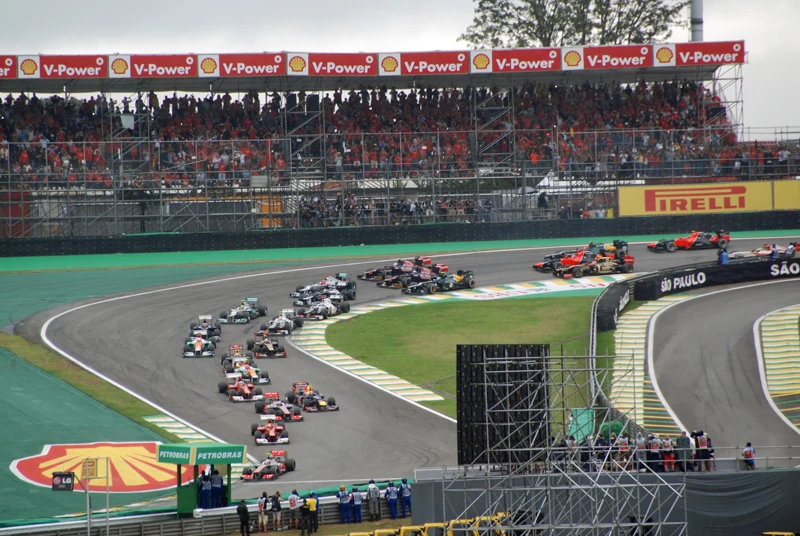
At today’s Interlagos, the Senna S takes the cars down from the opening left-hander, followed by the run towards Turn 4. The lap then works through the infield before climbing back towards the final part of the circuit. Formula 1’s description emphasises the changes of camber and the banked character inherited from the older design. The elevation is part of the racing problem, not merely scenery behind it. F1 circuit description.
Watch a car leaving Junção and accelerating uphill. The corner’s importance continues beyond its apex: a poor exit can leave a driver vulnerable during the following acceleration. Then compare the opening sequence, where braking and direction changes gather the cars together. Following one car through both areas makes the logic of a lap easier to read than memorising a string of turn numbers.
A map from the long-circuit era contains familiar names without necessarily giving them the same relationship to one another. Changes in route, facilities and safety provision mean that old photographs need their own year and location. For a history-minded visitor, the most rewarding exercise is to compare an old plan with the modern lap and look for the parts of the landscape that still organise the racing.
The event title changed to São Paulo Grand Prix from 2021 under the agreement announced by Formula 1 in December 2020. That was a naming and promotional change at Interlagos, not a transfer to a different circuit. It is why the same venue can appear under “Brazil” in older results and “São Paulo” in modern event branding. F1’s announcement of the São Paulo name.
The distinction has practical value when researching a trip. The historic Brazilian Grand Prix label can lead you to Rio material as well as São Paulo material; the present event’s visitor information should identify Interlagos. Use the current circuit plan for entrances and viewing areas, while letting the older diagrams explain how this compact venue emerged.
Great races and moments
Senna’s 1991 victory is an essential starting point. After repeated disappointments at home, he led in his McLaren before gearbox trouble made the closing laps a struggle. With only sixth gear available near the finish, he held on ahead of Riccardo Patrese. Formula 1’s retrospective describes the physical and emotional cost of finally securing that home win. F1’s account of the sixth-gear finish.
The official result gives Senna a 2.991-second advantage over Patrese. That small final gap tells only part of the story: the mechanical problem explains why a leading driver could be fighting to keep a race under control. Watch the slower corners as well as the finish, and the difficulty of carrying one usable gear around a varied circuit becomes easier to appreciate. 1991 Brazilian result.
Rain produced a very different outcome in 2003. Giancarlo Fisichella’s Jordan was eventually declared the winner after the race had been stopped, although Kimi Räikkönen initially received the victory through the countback calculation. The result was corrected in the days afterwards and Fisichella received the trophy before the next Grand Prix. It is a reminder that a red flag can make the timing rules decisive. F1’s history of Jordan’s final win.
Interlagos became the setting for a run of extraordinary championship decisions. In 2007 Kimi Räikkönen won the race and the title, while Lewis Hamilton finished seventh. Räikkönen’s 110-point total left Hamilton and Fernando Alonso tied on 109 in the final standings. The championship was settled by one point, after all three contenders reached the last race with a chance. 2007 classification.
The following year reversed Hamilton’s experience. Felipe Massa won the 2008 race for Ferrari, but Hamilton reached fifth and secured the championship by one point, as the final standings show. His pass on Timo Glock near the end of the final lap changed the title outcome after Massa had crossed the finish line. The winner’s celebration and the championship’s conclusion were therefore happening on different clocks. F1’s account of the 2008 decider.
That finish rewards a careful rewatch. Keep track of fifth place, rather than following only the leader, and notice how tyre choices become part of the outcome as rain returns. It explains a defining feature of attending a race in person: the car passing in front of you may matter to the championship even when it is nowhere near first place.
Jenson Button clinched his 2009 championship at Interlagos, recovering from 14th on the grid to fifth in the race. Mark Webber won that afternoon. Button’s achievement was securing enough points, rather than needing to turn his title confirmation into a race victory. It provides another useful example of a memorable championship celebration belonging to somebody other than the race winner. 2009 race result.
In 2012, Sebastian Vettel survived an opening-lap collision and recovered to sixth, enough to take the title ahead of Fernando Alonso. Jenson Button won the Grand Prix, with Alonso second and Felipe Massa third. The race combines changing conditions, a damaged contender and several simultaneous stories; following Vettel alone can make you miss why Button’s own performance mattered. 2012 classification.
The rain-affected 2024 race added a modern recovery drive to that collection. Max Verstappen climbed from 17th on the grid to victory, with Esteban Ocon and Pierre Gasly completing an Alpine double podium. F1’s report describes a race shaped by changing conditions, interruptions and opportunities. It is an instructive contrast with the 1991 struggle: different machinery and circumstances, but the same need to make a difficult afternoon work. F1’s 2024 race report.
Those races are our suggested viewing sequence for understanding Interlagos. They show a home favourite preserving a failing car, a result changed by the rules, several title fights and a recovery through a wet field. The shared setting makes those contrasting races easier to compare.
The British story at Interlagos
Begin by placing Nigel Mansell’s 1989 Brazilian victory in the right city. He won on his Ferrari debut at Jacarepaguá in Rio de Janeiro, not at Interlagos. The official result names the Rio circuit. It belongs to the broader Brazilian Grand Prix heritage, while illustrating exactly why the national race’s history and this circuit’s history need separate attention. Mansell’s 1989 result.
David Coulthard won at Interlagos in 2001 for McLaren, ahead of Michael Schumacher and Nick Heidfeld. His victory is a useful bridge between the Senna years and the later championship finales. British interest in Brazil did not begin with Hamilton, and it has not always involved a title being settled in the final corners. 2001 classification.
Button’s relationship with the circuit has two distinct peaks: confirming the championship in 2009 and winning the Grand Prix in 2012. The circumstances make a worthwhile comparison. In one race fifth place was sufficient for the season’s biggest prize; in the other he took the victory while another driver secured the title. It is a particularly clear example of how a race can carry several different definitions of success. Button’s 2012 win.
Hamilton’s 2021 São Paulo victory was a weekend-long recovery, including a difficult Sprint starting position and an engine penalty for the Grand Prix. On Sunday he started tenth, worked forward and passed title rival Max Verstappen to win. For a spectator, the overtakes make this an accessible race to follow: progress up the order is visible even without knowing every detail of the championship. F1’s 2021 report.
George Russell then claimed his first Grand Prix victory at São Paulo in 2022, with Hamilton second in a Mercedes one-two. Russell also won that weekend’s Sprint, but the Grand Prix victory remains the Sunday result. Keeping those competitions distinct matters when comparing winners, points and the scale of a breakthrough. Russell’s maiden Grand Prix win.
The British thread continued through the final season covered here. Lando Norris won the 2025 São Paulo Grand Prix from pole, ahead of Kimi Antonelli and Verstappen. The FIA’s report records his composed victory and Verstappen’s recovery from a pit-lane start to third. It is a fitting recent example of Interlagos producing a clear winner while substantial action unfolds behind. FIA’s 2025 race report.
Records and numbers
The figures in this section describe the Interlagos/Brazilian Grand Prix heritage as it stood at the end of 2025. Where a number covers the national event across two cities, that scope is stated rather than silently assigned to São Paulo.
| Item | Figure | Scope |
|---|---|---|
| Circuit opening | 12 May 1940 | The venue’s inauguration, before Formula 1 arrived. |
| First Formula 1 race here | 1972 | Non-championship event. |
| First championship round | 1973 | Won by Emerson Fittipaldi. |
| Modern lap length | 4.309 kilometres | The configuration used for the 2025 Grand Prix. |
| Alain Prost’s Brazilian wins | 6 | Only one at Interlagos, in 1990; the others were at Rio. |
| 2008 title margin | 1 point | Hamilton over Massa across the championship. |
The FIA’s 2025 press-conference introduction explicitly distinguishes Prost’s six Brazilian victories from his single Interlagos win. That distinction is more valuable than a headline number on its own. Brazil has had two championship venues, and successful drivers’ national-event totals can mix performances from both. FIA’s Prost comparison.
Similarly, 71 laps is the published Grand Prix distance for the normal 2025 event, while the stopped 2024 race has 69 laps in its official result. A historical result reflects what was actually classified on that afternoon. It should not be used to overwrite the standard lap count on a circuit diagram or a later event programme. 2025 event and circuit details.
A timeline
- 1940: Interlagos opens with motorcycle and car racing.
- 1972: The circuit stages a non-championship Formula 1 race.
- 1973: Fittipaldi wins the first world championship Brazilian Grand Prix.
- 1975: Carlos Pace wins at Interlagos.
- 1978: The championship’s Brazilian round moves to Jacarepaguá.
- 1979–1980: Interlagos briefly returns before the Rio years of 1981–1989.
- 1990: Formula 1 returns to a shortened São Paulo circuit.
- 1991: Senna finally wins his home Grand Prix.
- 2003: Fisichella is declared winner after the countback result is corrected.
- 2007–2009: Räikkönen, Hamilton and Button secure successive championships at Interlagos.
- 2012: Button wins while Vettel clinches another title.
- 2021: The São Paulo Grand Prix name begins; Hamilton wins.
- 2022: Russell takes his first Grand Prix victory.
- 2025: Norris adds another British victory to the circuit’s story.
The breaks in that timeline matter as much as the famous finishes. A sequence of Brazilian Grands Prix does not describe one unchanging circuit, while a sequence of Interlagos races includes many categories beyond Formula 1. Bring those two strands together and the modern Grand Prix acquires a much deeper sense of place.
See it for yourself
Use our São Paulo Grand Prix visitor guide to turn those stories into a workable visit. It covers the present-day trip from the UK, including bases, travel choices, tickets and the complete weekend budget. Choose your arrangements around Interlagos’ current entrances and event information rather than an old television camera position.
Think about which part of the history most interests you. Following the field through the opening sequence helps explain the crowded starts; watching the final climb makes late-lap pressure easier to understand. Compare those preferences with the organiser’s current grandstand plan, then read our guide to seating and general admission before buying.
For a long day in the stands, work through the first race weekend kit list. If children are travelling, the family F1 guide helps you prioritise hearing protection, breaks and a manageable day. Agree how your group will follow the race as well as where it will sit: timing and positions can explain action that happens outside your immediate view.
Take one historical question with you. It might be why fifth mattered in 2008, why Senna’s last laps were so difficult in 1991, or how the modern course fits inside the older venue. Finding the answer in the shape of the circuit is one of the pleasures of seeing Interlagos in person.
FAQs
Is the São Paulo Grand Prix held at the old Brazilian Grand Prix circuit?
The modern São Paulo Grand Prix is held at Interlagos, officially Autódromo José Carlos Pace. Interlagos hosted many Brazilian Grands Prix, but Rio de Janeiro’s Jacarepaguá also staged the national event, especially from 1981 to 1989.
Did Interlagos join the championship when it opened in 1940?
No. The circuit opened in May 1940, decades before it hosted Formula 1. Its first Formula 1 race was non-championship in 1972, followed by a world championship Brazilian Grand Prix in 1973.
Why is Senna’s 1991 home win so famous?
Ayrton Senna finally won in Brazil despite a failing gearbox that left him using sixth gear in the closing stages. He finished 2.991 seconds ahead of Riccardo Patrese, turning a difficult mechanical situation into an emotional home victory.
Did Hamilton win the 2008 Brazilian Grand Prix to take the title?
Felipe Massa won that race. Lewis Hamilton finished fifth, passing Timo Glock near the end of the final lap, and secured the drivers’ championship by one point. The Grand Prix winner and the new world champion were different drivers.
When did the event become the São Paulo Grand Prix?
Formula 1 announced the São Paulo Grand Prix name for the event from 2021, continuing at Interlagos. The change did not relocate the race to a new circuit. Hamilton won the first Grand Prix held under that name.
Sources
- Confirmed: Autódromo de Interlagos: official circuit history
- Confirmed: Autódromo de Interlagos: official timeline
- Confirmed: São Paulo City Hall: Interlagos at 70 and the Rio years
- Confirmed: Formula 1: Interlagos circuit introduction
- Confirmed: Formula 1: the São Paulo Grand Prix name from 2021
- Confirmed: Formula 1: Senna’s 1991 sixth-gear victory
- Confirmed: Formula 1: 1991 Brazilian Grand Prix result
- Confirmed: Formula 1: Mansell’s 1989 victory at Rio
- Confirmed: Formula 1: 2001 Brazilian Grand Prix result
- Confirmed: Formula 1: Jordan’s 2003 win and the corrected countback
- Confirmed: Formula 1: 2007 Brazilian Grand Prix result
- Confirmed: Formula 1: final 2008 drivers’ standings
- Confirmed: Formula 1: 2009 Brazilian Grand Prix starting grid
- Confirmed: Formula 1: 2009 Brazilian Grand Prix result
- Confirmed: Formula 1: 2012 Brazilian Grand Prix result
- Confirmed: Formula 1: the Interlagos championship deciders
- Confirmed: Formula 1: Hamilton’s 2021 São Paulo recovery win
- Confirmed: Formula 1: Russell’s first Grand Prix win, São Paulo 2022
- Confirmed: Formula 1: Verstappen’s 2024 wet-weather recovery
- Confirmed: FIA: Norris wins the 2025 São Paulo Grand Prix
- Confirmed: FIA: 2025 São Paulo press conference and Prost’s six wins
- Confirmed: Formula 1: 2025 São Paulo circuit facts and results
- Confirmed: Formula 1: 2024 São Paulo Grand Prix result
- Confirmed: Formula 1: final corrected 2003 Brazilian Grand Prix result
- Confirmed: Formula 1: 2008 Brazilian Grand Prix result
- Confirmed: Formula 1: final 2007 drivers’ standings