
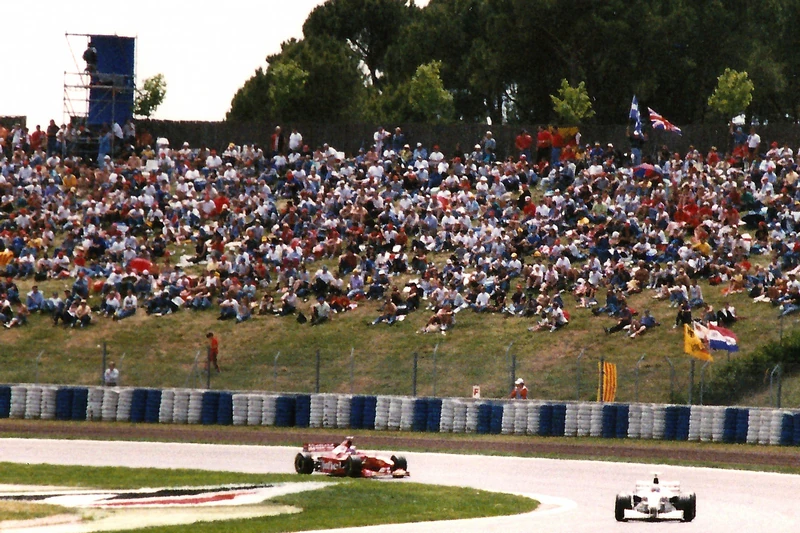
At a glance
The Spanish Grand Prix is a travelling history of Spanish motorsport: pre-war road races, two Barcelona street circuits, Jarama near Madrid, Jerez, the long Catalunya era and the move to the Madring. Knowing which venue a memory belongs to makes the race far easier to understand. A Mansell–Senna duel at Jerez and their famous Barcelona confrontation belong to the same event, but very different pieces of tarmac.
Spain entered the Formula 1 World Championship at Pedralbes on 28 October 1951, when Juan Manuel Fangio won for Alfa Romeo. The championship race subsequently visited Jarama, Montjuïc, Jerez and Barcelona-Catalunya before Madrid’s new venue made its 2026 debut. Historic results and records below are correct to the end of the 2025 season; the confirmed Madrid venue change is described separately. 1951 classification.
- First championship venue: Pedralbes, Barcelona.
- Longest modern chapter through 2025: Barcelona-Catalunya, beginning in 1991.
- Madrid distinction: the Madring around IFEMA is separate from the older Jarama circuit.
- For your trip: use the Spanish Grand Prix visitor guide for the current Madrid arrangements.
Our choice for a first historical watch is the 1986 Jerez finish, followed by the 1991 Barcelona race. Comparing those two afternoons reveals why a national Grand Prix cannot be reduced to one supposedly permanent character.
Origins
The name predates the championship that began in 1950. Bugatti’s account of Albert Divo records his victory in the 1923 Spanish Grand Prix at Sitges. That early banked-circuit chapter belongs to a different sporting landscape from today’s Formula 1: an older Grand Prix tradition, with its own cars and regulations. It explains why counting every Spanish Grand Prix produces a different answer from counting championship rounds. Bugatti on the 1923 race.
Northern Spain also mattered. The Real Automóvil Club Vasco Navarro traces international racing at Lasarte to its 1923 activities near San Sebastián. Its historical magazine describes the Lasarte meetings running from 1923 to 1935. Those meetings included different contests, so the circuit’s whole programme should not be mistaken for an uninterrupted annual sequence of Spanish Grands Prix. RACVN centenary history.
Lasarte was part of the international Grand Prix world before Formula 1 existed as a world championship. Bugatti identifies the Spanish Grand Prix at San Sebastián in September 1933 as the competition debut of its Type 59. That is a useful connection between a circuit name in a history book and an actual surviving type of racing machine. The Basque roads, Sitges banking and later championship venues are chapters in a national story, rather than successive versions of one circuit. Bugatti’s Type 59 history.
The championship’s Spanish debut came on the Barcelona streets at Pedralbes in 1951. Fangio’s victory put Alfa Romeo at the top of the result; Ferrari’s José Froilán González finished second. Formula 1’s historical account places the race at the end of the title fight, when Fangio secured his first championship. The event therefore entered the modern championship with a consequence larger than the destination itself. Pedralbes race result.
Pedralbes returned in 1954 and Mike Hawthorn won for Ferrari. Only those two Pedralbes races count in the championship’s Spanish venue list. Looking at a modern Barcelona map can make the distinction clearer: a former street route within the city and the purpose-built Catalunya track are not interchangeable places. For a visitor, the words “Barcelona race” need a date attached before they mean a precise location. 1954 result.
After the Pedralbes appearances, the championship’s Spanish race disappeared for more than a decade. Its next era involved a permanent circuit near Madrid and a parkland road course in Barcelona. That alternation created a particularly rich history: the event could move between cities while the Spanish Grand Prix title stayed familiar. FIA venue chronology.
How the circuits have changed
Jarama represented the move towards a dedicated racing facility. RACE’s circuit history dates its inauguration to 1967, describing the technical contribution of John Hugenholtz and the construction work led by Sandro Rocci. Its tightly folded layout and changing gradients gave the Madrid region a very different challenge from Pedralbes’ broad streets. The championship first raced there in 1968. Jarama’s own history.
Jarama alternated with Montjuïc: the Barcelona park course hosted the championship in 1969, 1971, 1973 and 1975. For the spectator watching archive film, the trees, road furniture and changing widths are part of the circuit’s identity. They are also reminders of the safety questions involved in turning public roads into a Grand Prix venue. The fatal accident at the 1975 race brought that Formula 1 chapter to an end. F1’s Montjuïc account.
Jarama then held the championship race from 1976 to 1979 and again in 1981. Its 1980 race took place but did not count towards the championship, a distinction preserved in the circuit’s own honours list. A photograph or programme carrying the 1980 event name is therefore genuine racing history without being evidence of another championship round. Jarama’s championship and non-championship races.
Jerez took the Spanish Grand Prix to Andalusia from 1986 to 1990. Its later Formula 1 associations include the 1997 European Grand Prix, but that title-deciding event was not a Spanish Grand Prix. It is an easy source of confusion when watching collections of Jerez highlights: venue history and event history overlap without matching exactly. FIA’s Jerez dates.
Barcelona-Catalunya became the home of the race in 1991. Its combination of faster corners and slower sections gave several generations of cars a common examination, although the layout itself evolved. In 2023 Formula 1 stopped using the final chicane, restoring the route through the last two sweeping corners. The circuit confirmed FIA-approved protective works for that change and a Grand Prix lap length of 4.657 kilometres. Circuit announcement for 2023.
That alteration matters when comparing footage. A slow change of direction before the main straight and two flowing final bends produce different approaches to the straight, different corner numbers and different lap times. A lap record belongs to a particular configuration. Looking first at the map prevents an apparently impressive comparison from mixing unlike routes.
Madrid’s new agreement was announced in January 2024 for 2026–2035. The Madring combines public-road and purpose-built sections around IFEMA; it is not a reopening of Jarama. F1’s September 2026 circuit guide gives the realised design as 5.414 kilometres and 22 turns. The earlier announcement contained provisional dimensions, so those early design figures should not be substituted for the published debut layout. F1’s Madring circuit guide.
RFEDA’s post-event account confirms the Madrid Grand Prix took place in September 2026. The change also restores a familiar theme: Spain’s Grand Prix has repeatedly found a new setting. The connection between Jarama and the Madring is the Madrid region and the event name, rather than a shared sequence of corners. An old Jarama grandstand photograph cannot tell you the sightline from a current Madring ticket.
Great races and moments
Jarama 1981 is the classic demonstration of a driver using a circuit’s strengths to contain faster-looking rivals. Gilles Villeneuve won, followed by Jacques Laffite, John Watson, Carlos Reutemann and Elio de Angelis. The official result puts the fifth car only 1.240 seconds behind the winner. The drama is not explained by the winning margin alone: the group remained close, yet the Ferrari stayed in front. 1981 classification.
Watch that race for the difference between catching and passing. Jarama’s corners repeatedly gathered the chase back together, while the following straight gave Villeneuve a way to protect his position. The circuit’s own recollection describes the Ferrari’s straight-line speed as central to his defence. It is a better lesson in racecraft than a simple claim that a close result automatically means frequent overtaking. Jarama’s account of Villeneuve’s defence.
Jerez introduced itself in 1986 with an almost inseparable finish. Ayrton Senna’s Lotus crossed the line 0.014 seconds ahead of Nigel Mansell’s Williams. A replay viewed from the line communicates the uncertainty wonderfully: the cars look almost together, while the timing separates winner and runner-up. For a first-time fan, this is an excellent reminder that the full result can depend on fractions too small to judge from a single grandstand. Official Jerez result.
Barcelona’s first championship race in 1991 produced another Mansell–Senna confrontation, remembered for the pair running side by side along the straight. Mansell ultimately won for Williams, with Alain Prost second and Riccardo Patrese third. The famous wheel-to-wheel passage is one part of the afternoon, rather than the final finishing order frozen in motion. Watching the whole sequence gives the celebrated image its proper context. 1991 race classification.
Rain made 1996 a different kind of test. Michael Schumacher took his first Ferrari victory at Barcelona, a drive Formula 1 revisits as a landmark wet-weather performance. The appeal is in how the car moves and where the driver searches for grip. Pick a few corners and compare his approach on successive laps: changing confidence and traction become much easier to see than they are in a result table. F1’s 1996 retrospective.
The surprise of 2012 came from Williams. Pastor Maldonado beat Fernando Alonso and Kimi Räikkönen, completing 66 laps to secure his only Grand Prix victory. That result sits awkwardly with any idea that Barcelona always delivered an obvious winner. An established team returning to the top and a home favourite in pursuit gave the race a different emotional shape from the Schumacher years. 2012 result.
In 2016, Max Verstappen won his first race for Red Bull and became Formula 1’s youngest Grand Prix winner. The two Mercedes drivers had collided on the opening lap, leaving the contest to develop around Red Bull and Ferrari. Verstappen’s success still required him to manage the race and withstand Räikkönen’s pressure; the initial incident explains the opportunity, not the whole achievement. F1’s 2016 race report.
Those examples are worth watching in sequence. The same event has rewarded defence, a final-lap chase, wet-weather control and calm management of an unexpected opportunity. That variety is a stronger reason to explore Spanish Grand Prix history than a promise that one particular type of race will happen on your own visit.
The British story at the Spanish Grand Prix
Mike Hawthorn’s 1954 win supplies an early British landmark. Ferrari’s driver won on Pedralbes’ final championship appearance, long before the Catalunya circuit existed. Graham Hill later won Jarama’s first championship race in 1968, while Jim Clark had won a non-championship Formula 1 race there in 1967, as listed in Jarama’s own history. Keeping those two Jarama events separate gives both drivers their proper place. Hawthorn’s official result.
Jackie Stewart won the Spanish Grand Prix in three successive seasons, 1969–1971, across Montjuïc and Jarama. That sequence illustrates how a driver could dominate the event while facing a different circuit from one year to the next. The national race title joins the results together; the alternating venues explain why the footage looks so different. FIA’s winners and venue list.
James Hunt’s 1976 Jarama victory has an extra layer. His McLaren was initially disqualified for being too wide, before the win was reinstated on appeal. The final official classification shows Hunt ahead of Niki Lauda. A contemporary headline about a disqualification and the championship’s final result can therefore describe different stages of the same decision. F1’s account of the reinstated win.
Nigel Mansell’s Spanish wins came at Jerez in 1987 and Barcelona in 1991 and 1992. His narrow defeat in 1986 is almost as prominent in the event’s memory as those victories. Damon Hill then won at Barcelona in 1994, a success recalled in F1’s historical review. These are useful races for a British visitor to explore because they connect familiar drivers with more than one Spanish location. FIA historical winners.
Jenson Button’s 2009 success put Brawn ahead of Rubens Barrichello and Mark Webber in the Spanish result. It belongs to the remarkable opening phase of Button’s championship season, and adds a different team story to the event’s British connections. Watching his Brawn alongside the older Lotus, McLaren and Williams winners shows how much machinery can change while the sporting objective remains recognisable. 2009 Spanish classification.
Lewis Hamilton’s Spanish victories came in 2014 and 2017–2021, all for Mercedes. By the end of 2025 his six wins matched Michael Schumacher’s event total. They were all achieved at Barcelona-Catalunya, so that shared Spanish Grand Prix record should not be presented as evidence of success at Jarama, Jerez or Madrid. The venue still matters, even when the headline statistic is correct. FIA’s Hamilton and Schumacher summary.
Records and numbers
These figures refer to championship Spanish Grands Prix and are correct to the end of the 2025 season. Pre-war meetings and Jarama’s non-championship races belong in the history but are outside this particular count.
| Landmark | Figure | Why it matters |
|---|---|---|
| Championship debut | 1951 | Pedralbes, won by Fangio. |
| Championship venues through 2025 | 5 | Pedralbes, Jarama, Montjuïc, Jerez and Barcelona-Catalunya. |
| Most event wins | 6 each | Michael Schumacher and Lewis Hamilton. |
| 1986 Jerez winning margin | 0.014 seconds | Senna ahead of Mansell. |
| Verstappen’s age at his 2016 win | 18 years, 228 days | The youngest Grand Prix winner. |
The youngest-winner figure comes from Formula 1’s contemporary statistics, while the event-win comparison is supported by the FIA’s historical summary and subsequent official results. Verstappen’s victories in 2022, 2023 and 2024 left those six-win totals unchanged. For Barcelona’s final pre-Madrid Spanish Grand Prix in 2025, the winner was Oscar Piastri. That result supplies a clear end point for the long Catalunya sequence covered here. 2025 Spanish result.
Numbers become more useful when their boundaries are visible. Five venues through 2025 does not contradict the addition of a sixth in 2026. Likewise, a national-event win total can span circuits, while a circuit lap record cannot. Read the date and the category before turning a statistic into a comparison.
A timeline
- 1923: Albert Divo wins the Spanish Grand Prix at Sitges; Lasarte’s international racing programme also begins in this period.
- 1933: Bugatti’s Type 59 makes its competition debut at the Spanish Grand Prix in San Sebastián.
- 1951 and 1954: Pedralbes hosts the first two championship Spanish Grands Prix.
- 1967–1968: Jarama opens, then joins the championship.
- 1969–1975: Montjuïc stages four championship races during the alternation with Jarama.
- 1981: Villeneuve wins Jarama’s final championship Grand Prix.
- 1986–1990: Jerez holds five Spanish Grands Prix.
- 1991: Mansell wins the first Barcelona-Catalunya edition.
- 2016: Verstappen becomes the youngest Grand Prix winner.
- 2023: F1 returns to Barcelona’s final two corners without the chicane.
- 2024: The Madrid agreement is announced.
- 2026: The Madring makes its Formula 1 debut.
Follow this chronology geographically as well as by year: the Basque Country, Barcelona, the Madrid region and Andalusia all contributed. It is a race history with several local identities. The modern Madrid chapter makes more sense when seen as another change in that pattern, rather than the beginning of Spanish Grand Prix racing.
See it for yourself
Plan the present-day trip with our Spanish Grand Prix visitor guide. It is the place to compare Madrid bases, arrival choices, ticket types and the journey back after racing. Keep the history as something to enjoy alongside that plan: memories of Barcelona or Jerez should not determine the gate, hotel or transfer for a Madring booking.
Before choosing a seat, read grandstand or general admission and decide what you want to watch. A view of a braking zone helps explain close pursuit; a faster section makes the cars’ direction changes easier to appreciate. Use the organiser’s current map to connect that preference to the actual ticket on offer.
Our first race weekend kit guide helps with the long day outdoors, while F1 with kids focuses on the pace and comfort of a family visit. If the journey is part of the holiday, explore F1 by train before comparing the full travel cost.
For an enjoyable introduction, watch Jerez 1986 and Barcelona 1991 before travelling, then look at the current Madring circuit diagram. The differences become a feature of the weekend: you can recognise the event’s inheritance while discovering a new racing setting for yourself.
FAQs
When did the Spanish Grand Prix first join the world championship?
The championship debut was at Pedralbes in Barcelona on 28 October 1951. Juan Manuel Fangio won for Alfa Romeo. Earlier races carrying the Spanish Grand Prix name, including the 1923 Sitges event, belong to the pre-championship history.
Was the old Madrid race held at the Madring?
No. Jarama hosted championship Spanish Grands Prix between 1968 and 1981, with gaps and an alternation with Montjuïc. The Madring around IFEMA is a separate venue that made its Formula 1 debut in 2026.
Why does Jerez also appear in European Grand Prix histories?
Jerez staged the Spanish Grand Prix from 1986 to 1990, then also hosted European Grands Prix. Its 1997 championship decider carried the European title, so it is circuit history without being another Spanish Grand Prix.
Which Spanish race finished just 0.014 seconds apart?
The 1986 Spanish Grand Prix at Jerez ended with Ayrton Senna’s Lotus 0.014 seconds ahead of Nigel Mansell’s Williams. It is separate from the pair’s celebrated side-by-side contest at Barcelona in 1991.
Who held the Spanish Grand Prix wins record through 2025?
Michael Schumacher and Lewis Hamilton shared the record with six championship Spanish Grand Prix wins each. Both scored all six at Barcelona-Catalunya. The statistic is an event record, with the cut-off at the end of the 2025 season.
Sources
- Confirmed: Formula 1: five historic Spanish Grand Prix venues
- Confirmed: RACVN magazine, June 2022: Lasarte racing, page 6
- Confirmed: RACVN: the club centenary and early Lasarte meetings
- Confirmed: Bugatti: Albert Divo and the 1923 Spanish Grand Prix
- Confirmed: Bugatti: Type 59 debut in San Sebastián, 1933
- Confirmed: Formula 1: 1951 Spanish Grand Prix result
- Confirmed: Formula 1: 1954 Spanish Grand Prix result
- Confirmed: Jarama-RACE: circuit history
- Confirmed: Jarama-RACE: the 1981 race and winners list
- Confirmed: FIA: 2018 Spanish Grand Prix historical preview
- Confirmed: FIA: 2022 Spanish Grand Prix historical statistics
- Confirmed: Formula 1: the 1976 season and Hunt’s reinstated Spanish win
- Confirmed: Formula 1: 1981 Spanish Grand Prix result
- Confirmed: Formula 1: 1986 Spanish Grand Prix result
- Confirmed: Formula 1: 1991 Spanish Grand Prix result
- Confirmed: Formula 1: Schumacher’s first Ferrari win, Spain 1996
- Confirmed: Formula 1: 2009 Spanish Grand Prix result
- Confirmed: Formula 1: 2012 Spanish Grand Prix result
- Confirmed: Formula 1: Verstappen’s first win, Spain 2016
- Confirmed: Formula 1: Verstappen’s age and records in 2016
- Confirmed: Formula 1: 2025 Spanish Grand Prix result
- Confirmed: Circuit de Barcelona-Catalunya: the 2023 layout change
- Confirmed: Formula 1: Madrid agreement, 2026–2035
- Confirmed: Formula 1: Madring circuit guide, September 2026
- Confirmed: Formula 1: historic Spanish Grand Prix moments
- Confirmed: RFEDA: Madrid Grand Prix, September 2026
- Confirmed: Formula 1: 1976 Spanish Grand Prix final result
- Confirmed: Formula 1: 2022 Spanish Grand Prix result
- Confirmed: Formula 1: 2023 Spanish Grand Prix result
- Confirmed: Formula 1: 2024 Spanish Grand Prix result