
At a glance
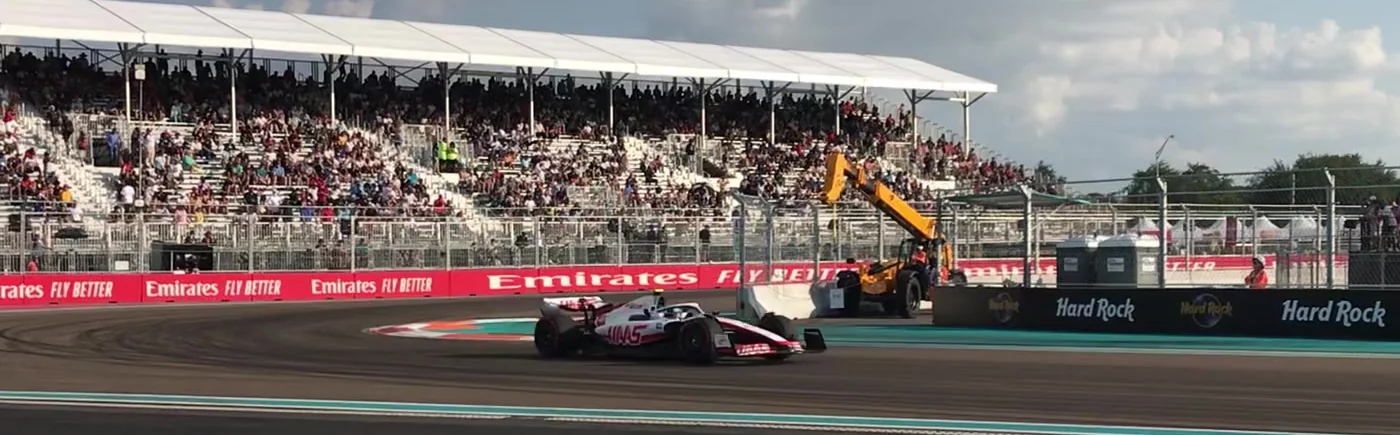
The Miami Grand Prix is Formula 1’s stadium-campus race in Miami Gardens, Florida. It debuted in 2022 around the Hard Rock Stadium, adding a second American meeting alongside Austin at the time. The setting immediately made the event recognisable: a major sports venue sits inside a purpose-designed racing lap, rather than simply providing a grandstand beside it. The original F1 announcement.
Its first four Grands Prix divided neatly between two teams. Max Verstappen won for Red Bull in 2022 and 2023; Lando Norris and Oscar Piastri then won for McLaren in 2024 and 2025. Those results trace a change in competitive strength, from Red Bull’s early command to the papaya cars’ breakthrough and subsequent superiority. The 2025 classification.
The strongest British connection is Norris’s first Grand Prix victory in 2024, achieved at his 110th attempt. Miami gave him a defining career moment, but its short history also contains Verstappen’s recovery from ninth, an inventive circuit built around existing infrastructure and a wet Sprint that upset the expected order. There is plenty to understand beyond the television images of hospitality and famous guests. Norris’s breakthrough race.
Origins
Formula 1 confirmed Miami’s arrival on 18 April 2021, with a ten-year agreement beginning the following season. The race was to be held at the home of the Miami Dolphins in Miami Gardens. It restored Florida to the Formula 1 calendar for the first time since 1959, when the World Championship had visited Sebring, while creating a separate Grand Prix identity from the United States event in Texas. The 2021 agreement.
The path to the stadium was not the original plan. Formula 1’s account of the design process describes downtown layouts being investigated in August 2017, followed by a move of attention to the northern site two years later. Across the proposed locations, the project developed 75 layout variations; at the stadium site alone, 36 alternatives were simulated before the selected route emerged. How the site was chosen.
That process is a useful correction to the idea that an empty expanse around a stadium offered unlimited freedom. The circuit had to coexist with the sports campus, tennis facilities, drainage, access roads and highway infrastructure. Its unusual slow section reflects the physical compromises of the site. Seen from that perspective, the lap is a solution to a collection of constraints, as well as an attempt to produce good racing. The design challenge.
The Miami International Autodrome name was announced in September 2021. The resulting event belonged to Miami Gardens rather than a course along the city’s beach or downtown waterfront. That distinction helps make sense of the photographs: the stadium is the geographical centre of the racing story, and the surrounding campus provides much of its visual character. The circuit’s name and location.
How the circuit has changed
The original lap measured 5.412 kilometres and contained 19 corners. Fast opening bends, long acceleration sections and the tight sequence towards the end of the second sector gave teams different demands to reconcile. A car needed enough straight-line performance to attack and defend, yet also sufficient confidence through the connected corners. The circuit’s temporary status did not mean its design followed an ordinary public-road journey. F1’s original circuit guide.
The most distinctive compression comes around Turns 13–16. Here the track negotiates uneven ground, an exit ramp and nearby flyovers. The Turn 14–15 chicane rises on approach, crests and drops away on exit. Understanding that small piece of terrain makes the awkward-looking section easier to appreciate: drivers are dealing with changes in direction and load while leaving very little room for error. The elevation changes.
For the second Grand Prix in 2023, organisers announced a complete resurfacing of the layout. The surrounding operation also changed: team hospitality units moved into a village on the stadium pitch, opening space in the paddock, and a permanent Paddock Club building was added above the garages. The circuit’s outline remained familiar while its surface and working environment underwent a substantial early revision. The second-year changes.
Those alterations reveal two histories developing together. One concerns the line driven by the cars and how the asphalt behaves. The other concerns how a busy sports campus accommodates a Formula 1 event. A spectator watching a later replay can still recognise the original turns, while the teams’ surroundings tell a story of rapid investment after the debut. The evolving stadium campus.
Miami added a Sprint in 2024, giving the weekend a separate short race as well as Sunday’s Grand Prix. Verstappen won that first Sprint from Leclerc and Sergio Perez, while Daniel Ricciardo held fourth. Norris retired after first-corner contact involving several cars. His Sunday breakthrough therefore followed a Saturday disappointment at the same venue, making the contrast within one weekend especially sharp. Miami’s first Sprint.
In 2025 the Sprint supplied the circuit’s first race in genuinely wet Formula 1 conditions, with rain delaying the start and a drying track creating a switch from intermediates to slicks. Hamilton later described it as the first wet running the drivers had experienced there. For an event usually introduced through sunshine, the changing surface offered a markedly different sporting picture. Hamilton on the wet Sprint.
Great races and moments
2022: the first Miami race
The inaugural Grand Prix on 8 May 2022 began with Ferrari occupying the front row. Verstappen started third, passed Sainz at the opening corner and took the lead from Leclerc at the beginning of lap nine. That early progress established a theme repeated across the event’s opening years: the first car on the grid would not necessarily be the first home. The inaugural Grand Prix.
A collision between Gasly and Norris brought out a late Safety Car, removing the comfortable shape the race had begun to take. Leclerc challenged after the restart, but Verstappen held on to win by 3.786 seconds. Sainz completed the podium. Miami’s opening result therefore came with a proper late contest, rather than just a ceremonial first appearance for a new track. The official 2022 result.
2023: recovery from ninth
The 2023 weekend first turned during qualifying. Verstappen aborted his opening attempt in the final session, then Leclerc crashed and brought out the red flag before he could recover with another lap. Perez secured pole, Alonso joined him on the front row and Verstappen was left ninth without a final-session time. It was a particularly inviting opportunity for the other Red Bull driver. The qualifying reversal.
Verstappen answered on Sunday by starting on hard tyres and extending his first stint deep into the race. Perez used mediums before switching to hards, so the team-mates reached the closing phase on opposing schedules. After stopping for fresh mediums, Verstappen caught and passed Perez with ten laps remaining. He won by 5.384 seconds, with Alonso third: a strategic recovery that also required decisive overtaking. The recovery from ninth.
The result is worth replaying with tyre age beside the running order. Perez could lead while Verstappen still owed a stop, but the question was how close the champion could return with fresher rubber. The hard tyre was a starting point for an attack much later in the afternoon. In a race remembered for a charge through the field, patience was part of the winning mechanism. The tyre strategies.
The 2023 classification also shows a race that kept its whole field running. All twenty drivers reached the finish, although Piastri and Sargeant were a lap down. Behind the podium, Russell, Sainz, Hamilton and Leclerc filled fourth to seventh, with the Alpines and Magnussen completing the points. The absence of a late retirement or neutralisation left the contrasting strategies to work themselves out through pace and overtaking. The full 2023 classification.
2024: Norris’s first Grand Prix win
Norris’s 2024 victory depended on another long opening stint. He began fifth, ran sixth early on and remained out as the other leaders changed tyres. The Safety Car after an incident involving Kevin Magnussen and Logan Sargeant then created his opportunity to stop and retain first place. Once racing resumed, Norris kept Verstappen behind and pulled away rather than merely protecting a narrow advantage. McLaren’s account of the win.
McLaren’s explanation also draws attention to the pace before the interruption. Norris had been quick towards the end of the opening stint, while Piastri initially occupied the stronger position for the team. The Safety Car favoured Norris, but the car’s speed made the opportunity useful. That combination of timing and performance is what makes the breakthrough more interesting than a simple lucky-stop description. How McLaren won.
2025: rain, then McLaren dominance
In 2025, Saturday’s Sprint produced a very different finish. Rain delayed the Sprint, Piastri took the lead from pole-sitter Antonelli and Norris benefited from a later Safety Car during the change to slick tyres. The McLarens finished first and second, with Hamilton third. Sunday’s winner had therefore been Saturday’s runner-up, giving the weekend two distinct stories even though one team occupied both leading places. The rain-affected Sprint.
The 2025 Sprint rewarded different decisions at different stages. Piastri gained track position at the start, Hamilton advanced by committing early to slick tyres, and Norris benefited from stopping during the later neutralisation. The same drying circuit therefore created several kinds of opportunity. Following those stops explains the final order more clearly than treating the rain as a single interruption before a normal short race resumed. Three routes through the wet Sprint.
In the 2025 Grand Prix, Piastri moved through from fourth on the grid to win ahead of Norris. Verstappen initially defended the lead from pole, but both McLarens eventually passed him and escaped. Piastri beat his team-mate by 4.630 seconds; Russell finished third, 37.644 seconds behind the winner. The podium gap captured just how far ahead the leading team had been. The commanding 2025 race.
The British story in Miami
Norris’s first Miami appearances gave little hint of the celebration to come. Contact with Gasly ended his 2022 Grand Prix; a year later he finished seventeenth, while Piastri was nineteenth. Seeing those results before the 2024 replay gives the achievement a different weight. The same team, at the same circuit, had moved from struggling for a meaningful result to beating the established winner. The difficult 2023 result.
Russell found a way through the first Miami race by starting on hard tyres and extending his opening run. He benefited from the late neutralisation, then passed Hamilton to finish fifth. Russell himself regarded the favourable timing as fortunate. It remains an instructive example for a new spectator: staying out longer can leave a driver exposed, but it can also create an opening that an early stop removes. Russell’s first Miami recovery.
In 2023 Russell improved to fourth and Hamilton recovered from thirteenth on the grid to sixth. Neither result challenged the dominant Red Bulls, but both provide a British thread through a race otherwise remembered for Verstappen and Perez. Trackside interest often lives in these smaller contests, especially when the lead battle spreads out over different tyre strategies. The Mercedes finishing positions.
Norris changed that balance on 5 May 2024. His 7.612-second winning margin over Verstappen followed the restart that had put his opportunity under immediate scrutiny. For British supporters, the lasting image is a driver converting a long-awaited chance into a convincing finish. The race had handed him an opening; the closing stint made the victory his own. Norris’s winning margin.
Hamilton’s third in the 2025 Sprint came after an early switch to slick tyres helped him advance in the drying conditions. Russell then took Mercedes’ first Miami Grand Prix podium on Sunday, while Norris finished second in the McLaren one-two. Across the weekend, three British drivers reached a top-three finish in one of the two races, each through a different route. The 2025 milestones.
Records and numbers
At the end of 2025, Miami had staged four championship Grands Prix. Verstappen led the driver win count with two; Norris and Piastri each had one. Red Bull and McLaren were tied on two constructor victories apiece. None of those four Grands Prix had been won from the front row: the winning starts were third, ninth, fifth and fourth respectively. The event’s early records.
The two most recent winning grid positions are confirmed by the official starting orders: Norris was fifth in 2024 and Piastri fourth in 2025. This is an interesting pattern in the opening sample, rather than a reason to discount qualifying. Each victory still required the driver to combine competitive pace with an effective route through the race. The 2025 grid.
Verstappen’s 1:29.708 in the 2023 Grand Prix remained the race-lap record through the end of 2025. The fastest race laps in the following editions were Piastri’s 1:30.634 and Norris’s 1:29.746. Race laps and qualifying laps answer different questions, so a faster Saturday pole time should not be confused with replacing that Sunday benchmark. The 2023 lap benchmark.
Piastri’s fastest lap in the 2024 race came on lap 43, after his additional stop for a damaged front wing. It was quicker than the winner’s best, yet Piastri finished thirteenth. That separation between outright lap speed and the final result makes a useful lesson in reading statistics: a fresh tyre and a recovery situation can produce a striking lap without changing the race’s central outcome. Piastri’s fastest race lap.
A timeline
- 2017: Downtown Miami layouts are investigated during the project’s early development.
- 2019: Attention moves to the Hard Rock Stadium site, requiring a route around an existing sports campus.
- 2021: Formula 1 announces the race, and the Miami International Autodrome receives its name.
- 2022: Verstappen wins the inaugural Grand Prix after starting third and resisting Leclerc’s late challenge.
- 2023: The circuit is resurfaced and team facilities expand; Verstappen wins from ninth on the grid.
- 2024: Miami stages its first Sprint, followed by Norris’s first Grand Prix victory on Sunday.
- 2025: Norris wins the wet Sprint; Piastri leads a decisive McLaren one-two in the Grand Prix.
In these few seasons, the race moved from design exercise to sporting landmark. The stadium remained the visual anchor, but the reasons to remember Miami changed: a first event, an exceptional recovery, a maiden winner and then a demonstration of McLaren’s strength. Watching the races in order makes that progression clear without needing decades of background knowledge. The breakthrough in the record.
See it for yourself
Start with our Miami Grand Prix visitor guide for the practical side of a first trip from the UK. The history suggests useful ways to think about viewing: a braking area can reveal the overtakes and defensive choices that decided these races, while the linked bends show the performance that made those attacks possible. Think about the racing you most enjoy before comparing individual grandstands.
Choose a replay to match that interest. The 2023 Grand Prix is particularly good for following different tyre strategies. The 2024 race carries the emotional arc of a first win, while the 2025 Sprint shows how quickly rain and a change of tyre can reorder a short event. A track map alongside the video helps connect the slow chicane, long acceleration zones and stadium setting.
Our grandstand or general admission guide, Sprint weekend explainer and first race weekend kit can help shape the rest of the experience. Miami’s compressed history is an advantage for a newcomer: a few carefully chosen races provide a useful grounding before you arrive, leaving more attention for the cars, their changing positions and the atmosphere around the stadium.
FAQs
When was the first Miami Grand Prix?
The first Formula 1 World Championship Miami Grand Prix took place on 8 May 2022. Max Verstappen won for Red Bull, ahead of the Ferraris of Charles Leclerc and Carlos Sainz. The race brought Formula 1 back to Florida for the first time since 1959.
Is the circuit on Miami’s beachfront?
The Miami International Autodrome runs around the Hard Rock Stadium campus in Miami Gardens. It is a temporary event layout woven around a working sports complex. Earlier downtown proposals were part of the project’s development, but the championship race that debuted in 2022 used the stadium site.
Why is the 2024 race so important to British fans?
Lando Norris took his first Formula 1 Grand Prix victory there, in his 110th start. He stayed out longer than the other leading cars, benefited from the timing of a Safety Car, then kept Max Verstappen behind at the restart and pulled clear. It was a major breakthrough for Norris and McLaren.
Who held Miami’s main records at the end of 2025?
Verstappen led the Grand Prix win count with two, followed by Norris and Oscar Piastri with one apiece. Red Bull and McLaren had two victories each. Verstappen’s 1:29.708 from the 2023 Grand Prix remained the race-lap benchmark after the 2024 and 2025 races.
Are the Miami Sprint and Grand Prix the same race?
They are separate competitions within the weekend. Verstappen won Miami’s first Sprint in 2024, while Norris won the Grand Prix. In 2025 Norris took the rain-affected Sprint and Piastri won Sunday’s Grand Prix. When comparing results or choosing a replay, check which event the result describes.
Sources
- Confirmed: Formula 1 — Miami Grand Prix joins the calendar in 2022 (18 April 2021)
- Confirmed: Formula 1 — Miami International Autodrome name announced (2 September 2021)
- Confirmed: Formula 1 — How the new Miami Grand Prix circuit was designed (18 April 2021)
- Confirmed: Formula 1 — Insider’s guide to the Miami International Autodrome (4 May 2022)
- Confirmed: Formula 1 — Miami resurfacing and stadium paddock changes for 2023 (18 January 2023)
- Confirmed: Formula 1 — Verstappen wins the inaugural Miami Grand Prix (8 May 2022)
- Confirmed: Formula 1 official results — 2022 Miami Grand Prix
- Confirmed: Formula 1 — Russell’s strategy and recovery in the inaugural Miami race (8 May 2022)
- Confirmed: Formula 1 — Perez takes pole as Leclerc’s crash leaves Verstappen ninth (6 May 2023)
- Confirmed: Formula 1 — Verstappen recovers from ninth to win Miami (7 May 2023)
- Confirmed: Formula 1 official results — 2023 Miami Grand Prix
- Confirmed: Formula 1 — Verstappen wins Miami’s first Sprint (4 May 2024)
- Confirmed: Formula 1 — Norris takes his first Grand Prix victory in Miami (5 May 2024)
- Confirmed: McLaren — 2024 Miami Grand Prix race report (6 May 2024)
- Confirmed: McLaren — How Lando Norris won the Miami Grand Prix (7 May 2024)
- Confirmed: Formula 1 official results — 2024 Miami Grand Prix, including post-race penalties
- Confirmed: Formula 1 — Norris wins the rain-affected Miami Sprint (3 May 2025)
- Confirmed: Formula 1 — Hamilton’s slick-tyre call and third place in the Miami Sprint (3 May 2025)
- Confirmed: Formula 1 — Piastri leads a McLaren one-two in Miami (4 May 2025)
- Confirmed: Formula 1 official results — 2025 Miami Grand Prix
- Confirmed: Formula 1 — Facts and statistics after the 2025 Miami Grand Prix (4 May 2025)
- Confirmed: Formula 1 official results — 2024 Miami Grand Prix starting grid
- Confirmed: Formula 1 official results — 2025 Miami Grand Prix starting grid
- Confirmed: Formula 1 official results — 2023 Miami Grand Prix fastest laps
- Confirmed: Formula 1 official results — 2024 Miami Grand Prix fastest laps
- Confirmed: Formula 1 official results — 2025 Miami Grand Prix fastest laps