
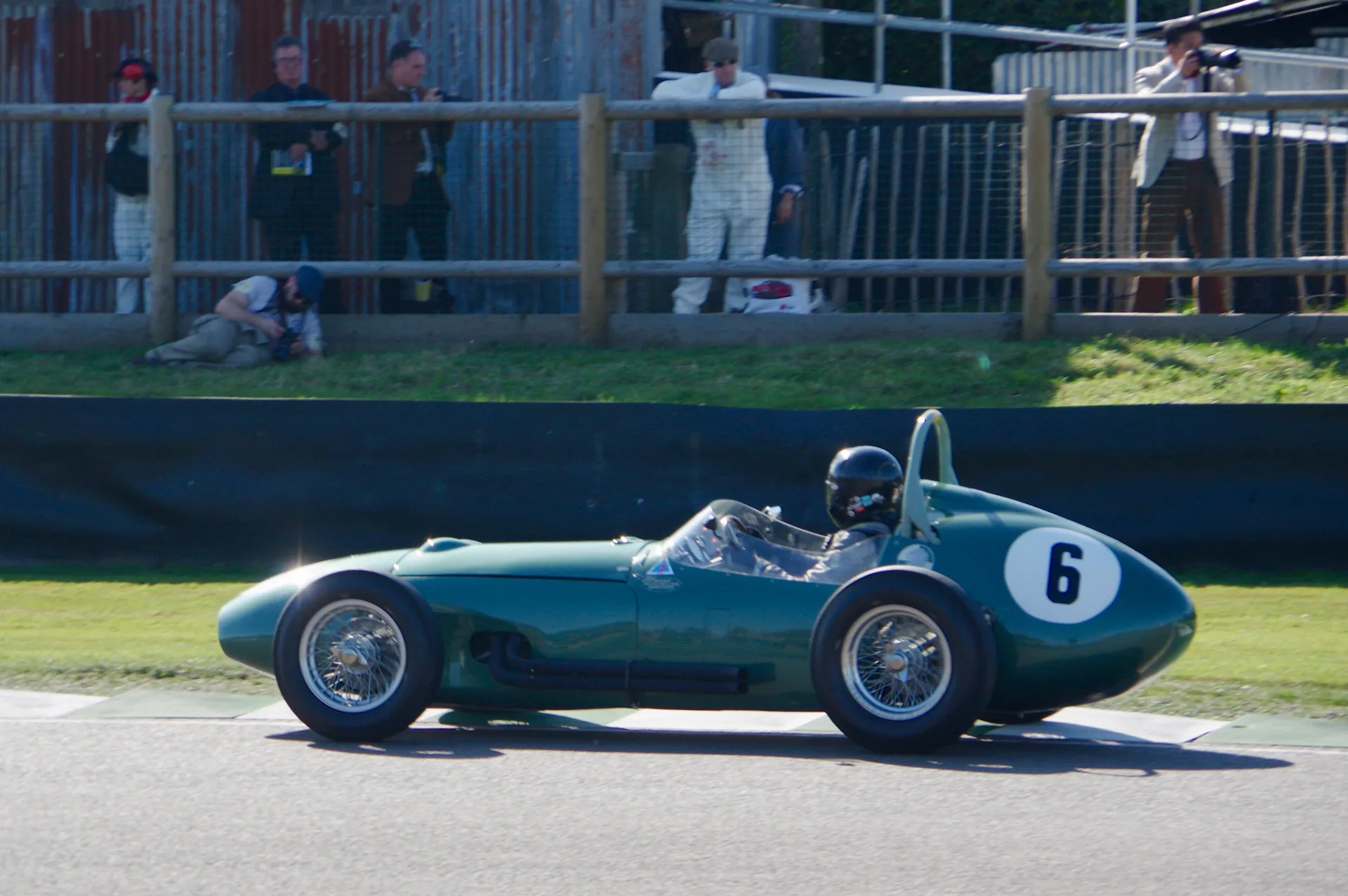
At a glance
The Goodwood Revival began on 18 September 1998, exactly 50 years after the Motor Circuit opened. Its foundation is the circuit’s original racing life from 1948 to 1966, around an airfield perimeter in West Sussex. The revived programme brings sports cars, saloons, single-seaters and motorcycles into active competition within a period setting. The Revival’s beginning The original era
Three dates make the story easy to follow: 1948 for the opening, 1966 for the end of contemporary racing, and 1998 for the return. Between them lie championship-deciding sports-car races, emerging British talent and a circuit whose corners became familiar to several generations.
- Original opening: 18 September 1948.
- Original racing period: 1948–1966.
- First Revival: 18 September 1998.
- Related tradition: Members’ Meetings ran from 1949–1966 and returned in 2014. The club-racing history
For a first-time visitor, the important connection is between the historical reference and the contest happening in front of you. A familiar badge or old-fashioned body shape can lead you into a thoroughly absorbing battle for position.
Origins
Goodwood’s Motor Circuit grew from RAF Westhampnett. Squadron Leader Tony Gaze, an Australian pilot who had been based there, suggested using the airfield’s perimeter road for racing. Freddie March, the ninth Duke of Richmond, took up the idea, and the Duke and Duchess opened the circuit in a Bristol 400 on 18 September 1948. The airfield transformation
The origin helps explain the lap’s character. An airfield perimeter supplied a flowing route around a large open site. The racing was being fitted to an existing landscape, and that relationship between sweeping corners and open space remains part of how the venue is understood.
Reg Parnell won the Goodwood Trophy for Formula 1 cars at the opening meeting in a Maserati 4CLT/48. Stirling Moss won the race for 500cc cars. The opening races These were distinct contests within one meeting, giving spectators several kinds of racing machinery to follow from the start of the circuit’s public life.
Goodwood’s Formula 1 races belonged to the non-championship calendar. They attracted leading drivers and meaningful competition alongside the World Championship rounds. Goodwood’s place in F1 That distinction helps make sense of the archive: an important F1 race at Goodwood can be absent from a championship results list while still forming a significant part of a driver’s career.
The venue developed a wider programme through the 1950s and early 1960s. The original Nine Hours races took place in 1952, 1953 and 1955, while the Tourist Trophy supplied major sports-car contests. The Nine Hours tradition The Tourist Trophy The modern race names preserve those associations, allowing a programme to act as a set of signposts into the circuit’s past.
Contemporary racing ended in 1966 as rising car performance increased concern about the suitability of the circuit. Goodwood then remained in use for testing. The end of the original era That later chapter includes a profound loss: Bruce McLaren died while testing an M8D Can-Am car there on 2 June 1970. McLaren’s account The landscape carries that history alongside the memories of competition.
The eventual Revival was therefore a return to a place with several layers of meaning: a wartime airfield, a major post-war race venue and a continuing working environment for racing teams. Understanding those layers gives the reconstructed period surroundings a firmer foundation than appearance alone.
How the circuit has changed
The Goodwood seen at the Revival preserves the character of the original racing era through restoration. Before the first modern meeting in 1998, the circuit was prepared to evoke its earlier appearance while meeting contemporary safety standards. The restored venue That combination made the return an exercise in operating historic machinery within a modern event.
The familiar route already contained developments made during the first racing period. The chicane near the pits was introduced for 1952 after concern about the speed of the fastest cars through that area. Goodwood’s historian Doug Nye connects the decision with the performance of Giuseppe Farina’s Alfa Romeo Alfetta in 1951. The chicane’s origin
That detail changes how an early photograph reads. The opening-year circuit and the later 1950s circuit share the same airfield outline, while the final approach to the line gained a new interruption. When watching a current race, follow how a driver prepares for the chicane after the much faster sections preceding it.
The revived programme has continued to evolve. In 2024 the entire race schedule used fuel required to contain at least 70 per cent advanced sustainable components. The 2024 requirement The cars retained their historical identities while the event adopted a new fuel specification. It is a concrete example of how preservation can include changes to the way the machinery is operated.
Members’ Meeting: the club-racing tradition
Members’ Meetings form a named chapter of Goodwood’s history in their own right. Seventy-one were held between 1949 and 1966 for members of the British Automobile Racing Club. The original events were less heavily promoted to public spectators than the major international meetings, and many early entrants drove their cars to and from the circuit. The original meetings
The first Members’ Meeting took place on 13 August 1949, with Len Gibbs winning the opening race in a Riley Nine. Some early contests lasted only three laps. The first meeting and short races Those details make the clubman’s day easier to imagine. A brief race gave the driver little time to recover a poor start, while a car needed to survive the competition and remain usable afterwards. The modest scale of the fixture was part of its particular appeal.
The early race cards concentrated on saloons and sports cars, with single-seaters added at the 32nd meeting in September 1958. The developing programme This club-racing strand gives Goodwood’s past a different scale from the famous Tourist Trophy. Alongside established stars, the venue served competitors whose sporting life depended on a workable weekend rather than a world championship campaign.
The final period meeting took place on 2 July 1966. Almost half a century later, the 72nd Members’ Meeting resumed the sequence in 2014. The last original meeting The modern return Keeping the numbering connected the new event directly to its predecessor.
Today’s Revival and Members’ Meeting share the Motor Circuit and an interest in historic competition, with their own programmes and identities. For the practical version of the latter, use the Goodwood Members’ Meeting visitor guide. Its history belongs here as part of the circuit’s continuing club-racing line.
Great races and moments
1952: Hawthorn makes an impression
At the Easter Monday meeting, Mike Hawthorn won the Lavant Cup and Chichester Cup in a Cooper-Bristol, then finished second to José Froilán González in the Richmond Trophy. Hawthorn’s breakthrough day The range of results explains why the meeting became such an important early landmark in his career.
It also shows how a period race meeting worked. A driver could appear more than once, facing different opposition across the programme. Follow the whole day in an archive account, and the reputation being built becomes easier to understand than it would from one isolated classification.
1952–1955: the Nine Hours
Aston Martin won all three original Goodwood Nine Hours races: the DB3 in 1952, then the DB3S in 1953 and 1955. The Freddie March Memorial Trophy at the Revival recalls that sequence of sports-car endurance racing. The original winners and modern tribute
The connection gives the cars a purpose beyond their shape. The spectator is looking at machines associated with sustaining speed over a long contest, and a race title that remembers what the circuit once asked of them. A shorter modern event can point towards that older endurance story without reproducing its full duration.
1959: Aston Martin takes the world title
The 1959 RAC Tourist Trophy ended with a world championship for Aston Martin after an extraordinary recovery. Moss and Roy Salvadori’s DBR1 caught fire during a pit stop. Moss transferred to the car shared by Carroll Shelby and Jack Fairman, then drove it to victory and secured the World Sportscar Championship for the manufacturer. The decisive race
Keep the team effort in view when revisiting this story. The driver’s recovery depended on a surviving car, team-mates and a functioning place to service it. The famous name taking the flag is the final part of a result created by several people responding to a major disruption.
1965: two Scots share a benchmark
Jim Clark won the Sunday Mirror Trophy on Easter Monday 1965. During the non-championship Formula 1 race, Jackie Stewart’s BRM P261 and Clark’s Lotus 25 each recorded a lap of 1 minute 20.4 seconds. It was the final contemporary F1 race at Goodwood. The shared lap record
The paired time is a memorable way into the final years of the original circuit. Watch a later historic single-seater race and look at how little bodywork sits between the driver and the surrounding air. The benchmark belongs to particular cars and a particular era, with all the demands that combination imposed.
1998: the opening gesture is repeated
The first Revival opened on 18 September 1998 with the Earl of March driving the Bristol 400 used by his grandparents at the 1948 opening. The repeated ceremony Film of the inaugural modern event shows racing, aviation displays and the period surroundings already combining into a recognisable occasion. The first Revival on film
The gesture made the reason for the return visible. A car crossing the same place fifty years later joined the two openings before the competitive programme supplied its own new memories.
2013: Bräck’s GT40 qualifying lap
Kenny Bräck’s wet-weather onboard in a Ford GT40 became one of the Revival’s most widely recognised films. It came from qualifying for the 2013 Whitsun Trophy, driving a car belonging to Adrian Newey. The qualifying film Its fame comes from the work visible at the steering wheel as the car responds to the wet circuit.
Watch the hands, then the road beyond them. The corrections show how continuously the driver is reading the available grip. It is an absorbing introduction for anyone who assumes older machinery is simply circulating for display.
2025: a modern TT contest in changing weather
The 2025 RAC TT Celebration brought a red flag and rain before its final order was settled. Tom Ingram and Richard Kent’s Jaguar E-type FHC won, ahead of Rob Huff and Andrew Bentley’s E-type after a penalty affected the leading car’s result. The final classification The driver pairings
The outcome closes this account’s sporting cutoff with a competitive decision, changing conditions and current drivers working historic cars hard. The Revival had developed its own racing archive while keeping the original circuit’s stories in view.
The British story at Goodwood
Moss’s association spans the circuit’s opening meeting, major sports-car victories and the modern return. His frontline career ended after an accident at Goodwood on 23 April 1962, yet he remained deeply connected with the venue and later became a founding Festival patron and a Revival participant. Moss’s Goodwood association The relationship contains both exceptional success and a difficult ending to his original racing career.
Surtees supplies another bridge between eras. He made his car-racing debut at Goodwood in March 1960, finishing second to Clark, and later helped establish the Festival of Speed’s motorcycle content. Surtees’s long connection His story helps explain why cars and bikes both belong within Goodwood’s modern sporting identity.
The contemporary Revival programme gives British saloon-car followers familiar names in unfamiliar machinery. Its 2025 St. Mary’s Trophy paired professional drivers and owners across two races for 1950s saloons, with the results combined. The saloon-racing format Watching the different body shapes through the same corner is a good way to appreciate the practical contrast between power, weight and agility.
Motorcycle racing has its own place in the programme through the Barry Sheene Memorial Trophy. The 2025 edition used two 25-minute races for 500cc Grand Prix machines of a type raced between 1948 and 1966, with shared riding duties and a combined result. The motorcycle programme Knowing the format helps the spectator follow what is happening during a changeover.
The Freddie March Memorial Trophy provides a particularly tangible British thread through the modern event. Gary Pearson won its first two editions in 1998 and 1999 in a Jaguar C-type. The first modern winners In 2025, Jenson Button and Alex Buncombe also won in a C-type, establishing an early lead that Buncombe preserved as rain arrived towards the finish. The 2025 opening race
Comparing those results shows how the revived meeting has accumulated its own generations of competitors. A car type associated with the 1950s can become the setting for a new partnership and a new performance decades later. For a fan following Button from Formula 1, the familiar driver supplies a route into an older kind of sports-car racing.
The British story is therefore wider than a succession of famous home drivers. It includes teams, specialist preparers, owners and clubs keeping the cars and motorcycles in working order. The most satisfying first visit leaves room to look closely at that labour as well as applaud the drivers passing at speed.
Records and numbers
This historical record picture ends in 2025. The original circuit era, its later historic races and the Festival’s separate Hill each need their own context.
| Measure | Figure and context |
|---|---|
| Original Motor Circuit opening | 18 September 1948. Opening history |
| First Revival | 18 September 1998, fifty years later. Revival history |
| Original Members’ Meetings | 71 meetings between 1949 and 1966; the modern sequence resumed at 72 in 2014. The original series The return |
| Period race-lap benchmark | 1 minute 20.4 seconds, shared by Clark and Stewart in the 1965 F1 race. The period record |
| 2025 RAC TT Celebration winners | Ingram and Kent, Jaguar E-type FHC. Final results |
The 1965 figure is attached to the original era. A modern qualifying lap, a later timed demonstration and a Festival Hill climb describe different exercises. Keep the vehicle, route and session attached to a time before comparing it with another.
A timeline
- 1948: The Duke and Duchess open the Motor Circuit; Parnell and Moss win at the first meeting. The opening The races
- 1949: The original Members’ Meeting series begins. The club tradition
- 1952: The chicane is introduced and the first Nine Hours takes place. The circuit change The endurance event
- 1959: Aston Martin wins the Tourist Trophy and World Sportscar Championship. The title decider
- 1962: Moss’s frontline career ends after his Goodwood accident. The difficult chapter
- 1965: Clark and Stewart share the period lap benchmark. The two record-holders
- 1966: The original racing era concludes; the last Members’ Meeting is on 2 July. The final meeting
- 1998: The Revival returns racing to the circuit. The reopening
- 2013: Bräck’s wet GT40 qualifying film captures the driving challenge. The onboard
- 2014: Members’ Meeting numbering resumes with the 72nd event. The second revival
- 2024: The Revival’s entire race programme adopts the new fuel requirement. The fuel milestone
- 2025: Ingram and Kent win the RAC TT Celebration. The classification
The sequence moves from a working post-war circuit to a modern event that remembers it through competition. A few well-chosen race films make those dates feel like stages in a continuing sporting life.
See it for yourself
The Goodwood Revival visitor guide brings tickets, transport and accommodation into one plan. Choose a few races to follow before the weekend. Recognising a trophy’s connection to the original circuit makes an unfamiliar programme much easier to navigate.
If the Formula 1 history caught your attention, compare the single-seater races and their eligibility periods. If you prefer road-car shapes, start with the saloons or GTs. The guide to choosing a UK race weekend helps you place those interests alongside other kinds of motorsport.
Study a current circuit map and find Madgwick, St. Mary’s, Lavant and the chicane before settling on a viewing plan. The seating and general admission guide can help you compare the view, the walking involved and the value of a reserved place. Use the paddock guide for the separate question of seeing cars close up.
For a first outing, a small viewing routine works well: watch one race from start to finish, spend time examining a contrasting class of machinery, then return to the track with those details in mind. The different proportions, tyres and driving positions become easier to recognise once you have seen the cars stationary.
Prepare with the weekend kit list and, where relevant, motorsport with kids. For the related club-racing event, follow the Members’ Meeting visitor guide. You can also explore Festival of Speed history to see how the wider Goodwood revival began on the estate roads.
FAQs
When did the Goodwood Revival begin?
The first Revival opened on 18 September 1998, exactly fifty years after the Motor Circuit’s original opening on 18 September 1948.
Which years of Goodwood history does the Revival celebrate?
Its central reference is the Motor Circuit’s original racing period from 1948 to 1966. The programme brings historic cars and motorcycles back into competition within a period setting.
Was Goodwood a Formula 1 World Championship venue?
Goodwood hosted significant non-championship Formula 1 races. Its final contemporary F1 race was in 1965, when Jim Clark and Jackie Stewart shared a 1 minute 20.4-second lap benchmark.
How does Members’ Meeting fit into the story?
The original 71 Members’ Meetings ran between 1949 and 1966. The sequence resumed with the 72nd meeting in 2014, creating a distinct modern event on the same Motor Circuit.
Is Revival racing a demonstration?
The Revival includes competitive races with qualifying, results and different class formats. Demonstrations and commemorative activities also contribute to the weekend, so check the label on the session you are watching.
Sources
- Confirmed: Goodwood: 75 years of motorsport, 2023 retrospective
- Confirmed: Goodwood: Surtees’s circuit debut and Festival patronage
- Confirmed: Goodwood: 2018 Revival anniversary and the circuit restoration
- Confirmed: Goodwood: the completed 2025 Revival weekend
- Confirmed: Goodwood: Revival history and the 1998 reopening
- Confirmed: Goodwood: the opening meeting of 18 September 1948
- Confirmed: Goodwood: Freddie March and the circuit’s original era
- Confirmed: Goodwood: the 1952 chicane and the Alfetta
- Confirmed: Goodwood: the 1959 RAC Tourist Trophy and Aston Martin’s title
- Confirmed: Goodwood: Clark and Stewart’s shared 1965 lap record
- Confirmed: Goodwood: why its non-championship F1 races mattered
- Confirmed: McLaren: Bruce McLaren’s fatal Goodwood test in 1970
- Confirmed: Goodwood: film of the 1998 Revival reopening
- Confirmed: Goodwood: the original Members’ Meetings, 1949–1966
- Confirmed: Goodwood: club racing and the final 1966 meeting
- Confirmed: Goodwood: Stirling Moss’s association and 1962 accident
- Confirmed: Goodwood: Freddie March Trophy and the original Nine Hours
- Confirmed: Goodwood: 2024 Revival racing and fuel requirements
- Confirmed: Goodwood: the 2025 Revival race programme
- Confirmed: Goodwood: final 2025 Revival race results
- Confirmed: Goodwood: Bräck’s 2013 GT40 qualifying onboard